| Modern robotic design presents a persistent engineering paradox. Designers face increasing pressure to deliver higher payload-to-weight ratios while simultaneously shrinking the physical footprint of critical joints like the waist, elbow, and wrist. Traditional bearing arrangements often fail to meet these conflicting demands without sacrificing rigidity or adding excessive bulk. The industry standard solution to this challenge is the crossed roller bearing. By utilizing a unique internal geometry, these components effectively replace double-row ball bearing assemblies with a single, compact unit. However, selecting the right bearing is not merely about checking dimension sheets. This article moves beyond basic definitions to evaluate structural trade-offs, stiffness-to-torque ratios, and the harsh installation realities that directly impact the Total Cost of Ownership (TCO) for high-precision robotic applications. We will explore how to engineer joints that are both compact and incredibly rigid. Key Takeaways
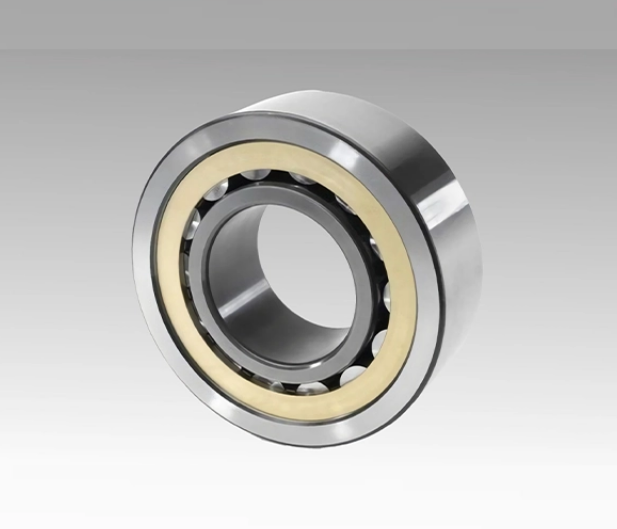
The Engineering Case: Why Switch to a Crossed Roller Bearing?The transition from traditional ball bearings to crossed roller designs is rarely about cost reduction alone; it is fundamentally about performance density. To understand why these components dominate the robotics sector, we must analyze the physics of their load-handling capabilities. The Geometry of Load HandlingThe defining feature of this bearing type is the orthogonal arrangement of cylindrical rollers. Inside the raceway, rollers are positioned at alternating 90-degree angles within a V-groove. This configuration creates a fundamental shift in contact mechanics. Standard ball bearings rely on "point contact." When a load is applied, the stress concentrates on a microscopic point between the ball and the raceway. Under heavy loads, this point deforms, leading to elastic deflection. In contrast, a crossed roller bearing utilizes "line contact." The cylindrical roller makes contact along its length. This distributes stress over a much larger area, significantly increasing the load-bearing threshold before deformation occurs. The outcome of this geometry is multidirectional load handling. A single raceway can simultaneously support:
Comparative Rigidity AnalysisRigidity is the primary currency in robotic arm design. A compliant joint leads to end-effector vibration, poor repeatability, and "droop" when the arm is fully extended. Industry benchmarks consistently demonstrate that crossed roller arrangements deliver 3–4 times the rigidity of angular contact ball bearings of similar dimensions. For a robotic joint, this stiffness minimizes deflection. In high-precision rotary tables or semiconductor handling robots, even a few microns of deflection at the pivot point can translate to millimeters of error at the tool tip. The line-contact structure ensures that the joint remains stiff even under heavy cantilevered loads. Component Reduction & SimplificationSimplifying the bill of materials (BOM) is a significant advantage. In traditional designs, supporting a joint often requires two angular contact bearings mounted back-to-back or face-to-face to handle moment loads. This requires a wider housing and complex shimming to set the preload. Engineers can execute a "1-for-2" swap using a crossed roller design. One bearing performs the work of two angular contact pairs. This reduction impacts the entire design:
Evaluating Internal Structures: Cages, Separators, and Full ComplementNot all crossed roller bearings are created equal. The internal structure—specifically how the rollers are separated—dictates the suitability for specific robotic tasks. Engineers must choose between load capacity and rotational smoothness. Full Complement vs. Caged DesignsA "full complement" design removes the separator between rollers. This allows the manufacturer to pack the maximum number of rollers into the raceway. Pros: This yields the highest possible load capacity and rigidity because there is more steel supporting the load. Cons: Adjacent rollers rub against each other (counter-rotational friction), leading to higher torque and heat generation. These are best suited for low-speed, heavy-payload joints, such as the waist of a heavy palletizing robot. Conversely, caged or separated designs place a spacer between rollers. This prevents roller-to-roller contact. These are vital for high-speed pick-and-place robots where low friction and smooth rotation are prioritized over maximum static load capacity. Material Selection: Resin vs. Metal RetainersIf you select a separated design, the material of the separator matters. Separator TypeCharacteristicsIdeal ApplicationResin SeparatorsMolded thin profile allows tighter roller spacing. Provides approx. 30–58% more contact area than metal cages.Standard industrial robots requiring high load density.Metal CagesRobust, temperature resistant, no outgassing. slightly lower roller count due to thicker cage bars.Vacuum environments, cleanrooms, and high-temperature zones.Resin separators have become the default for general automation because they boost load capacity significantly. However, metal cages remain a strict requirement for environments where outgassing from plastics could contaminate sensitive products, such as in semiconductor manufacturing. Addressing "Cage Creep"Robotic joints frequently operate in oscillating modes—moving back and forth 45 degrees rather than rotating continuously. This can lead to "cage creep," where the retainer gradually shifts from its centered position. Eventually, the cage may hit the travel limit or cause sliding friction rather than rolling motion. For vertical axis applications where gravity exacerbates this issue, engineers should evaluate anti-creep mechanisms. Solutions such as studded roller systems (rack-and-pinion style engagement) mechanically force the cage to stay aligned, preventing travel limitation errors. Critical Performance Metrics: Torque, Precision, and Energy EfficiencyBalancing rigidity against efficiency is the central trade-off in robotic drivetrain design. A high precision crossed roller bearing must be specified with the correct preload and accuracy class to function correctly. The Stiffness vs. Torque Trade-offPreload involves manufacturing the bearing with negative internal clearance (often designated as CC0). This ensures that the rollers are under compression even before an external load is applied. Decision Framework:
Engineers must calculate whether the motor has sufficient torque to overcome the bearing's starting friction, particularly in cold environments where grease viscosity increases. Rotational Accuracy ClassesAccuracy classes define the runout tolerances of the bearing. P0 (Standard): Sufficient for most industrial arms, packaging machines, and welding robots. The runout is controlled but cost-effective. P4 / P2 (Ultra-Precision): These are necessary for applications where position reliability is non-negotiable. Surgical robotics and semiconductor wafer handling require P2 grade accuracy to ensure the end-effector lands within microscopic targets. Impact on Energy ConsumptionEfficiency is not just about battery life; it is about heat management. A large differential between static torque (break-away) and dynamic torque (running) causes uneven motor strain. Crossed roller bearings with optimized separators minimize this differential. Smoother rotation reduces the current spike required to initiate movement, lowering the overall thermal load on the joint assembly. Installation Realities and Structural TypesThe most common failure mode for these bearings is not fatigue; it is improper installation. The structural design of the bearing rings dictates how they must be mounted. Choosing the Ring ConfigurationManufacturers offer different ring structures to suit which part of the robot is rotating.
The "2-Micron" Flatness RuleInstallation surfaces must be machined to extreme precision. Unlike ball bearings, a high precision crossed roller bearing is unforgiving of housing imperfections. Because the internal clearance is negative (preloaded), any distortion in the housing transfers directly to the raceway. If the mounting flange is not flat, tightening the bolts will warp the ring. This creates tight spots in the raceway, leading to torque spikes and rapid wear. A general rule of thumb for ultra-precision grades is that mounting surface flatness should be within 2 to 5 microns. Procurement specialists must ensure that machining partners can consistently hit these tolerances. Shaft and Housing FitsInterference fits require caution. Pressing a split-ring bearing into an undersized housing can compress the outer ring, further reducing the internal clearance. This artificially increases the preload, potentially causing the bearing to seize or wear out prematurely. Engineers should aim for transition fits or very light interference fits, relying on the mounting bolts and flange friction to hold the position. Lifecycle and Maintenance ConsiderationsOnce designed and installed, the long-term reliability of the joint depends on maintenance strategies tailored to robotic use cases. Lubrication StrategiesStandard lithium-based greases work for general industrial robots. However, many modern applications operate in specialized environments. In semiconductor or space applications, standard grease outgasses, coating lenses and sensors in a fine film. Vacuum-compatible lubricants are required. Additionally, the seal design is critical. Open bearings offer less friction but zero protection. For welding environments (metal dust) or cleanrooms, sealed designs are mandatory to keep contaminants out and lubricant in. Calculating Service Life (L10)Calculating the L10 life (the time at which 90% of bearings will still be functional) for robots is complex. Robots rarely rotate continuously in one direction. They oscillate. The calculation must account for this oscillation. Furthermore, the "Dynamic Equivalent Load" formula must heavily weight the moment load component. A robot arm fully extended places a massive moment load on the waist bearing, far exceeding the impact of the arm's dead weight alone. Ignoring the moment load in life calculations is a primary cause of unexpected field failures. ConclusionThe adoption of the crossed roller bearing is a strategic enabler for modern robotics. It allows for slender, aesthetically pleasing, and highly functional designs that do not compromise on strength. By providing high rigidity in a compact footprint, these bearings solve the fundamental space-vs-strength paradox. When approaching the "Buy vs. Build" decision, consider integrated units for faster assembly, despite the higher upfront component cost. For custom, ultra-compact joints, separate ring sets offer flexibility but demand rigorous machining tolerances. Before freezing any design, prioritize an accurate calculation of moment loads. Ensuring the bearing can handle the dynamic tilting forces of the robot arm is the single most important step in guaranteeing a long service life. FAQQ: What is the difference between a crossed roller bearing and a 4-point contact ball bearing?A: The main difference is the contact area. 4-point contact ball bearings use balls, creating point contact. Crossed roller bearings use cylindrical rollers, creating line contact. This line contact provides significantly higher rigidity (3–4 times higher) and load capacity relative to the bearing's size. While 4-point bearings are cheaper and handle higher speeds, crossed roller types are superior for precision, stiffness, and moment load handling. Q: Can crossed roller bearings handle high-speed rotation?A: Generally, no. They are designed for high rigidity and precision, not high speed. The crossed arrangement creates more friction than ball bearings due to the rollers' contact area. For high-speed applications (like spindles), angular contact ball bearings are preferred. However, using caged/separated crossed roller designs can allow for moderate speeds suitable for most robotic joint movements. Q: How does preload affect the life of a crossed roller bearing?A: Preload increases rigidity and eliminates backlash, which is good for accuracy. However, excessive preload increases internal stress and friction. If the preload is too high, it effectively adds a permanent load to the rollers, which reduces the fatigue life (L10) of the bearing. The goal is to select the minimum preload necessary to achieve the required stiffness without overburdening the rolling elements. Q: Why is my crossed roller bearing generating excessive heat?A: Excessive heat usually stems from three causes: excessive preload (often caused by an interference fit that is too tight), over-lubrication (causing churning drag), or mounting surface distortion. If the mounting surface isn't flat, the ring warps, creating pinch points that generate friction and heat. Checking the housing flatness and fit tolerances is the first step in troubleshooting. Q: Are crossed roller bearings suitable for vacuum environments?A: Yes, but they require specific modifications. Standard bearings use grease and seals that may outgas in a vacuum. For vacuum use, you must specify a bearing with vacuum-compatible grease (like fluorinated lubricants) and often a stainless steel construction to prevent cold welding. You may also need to use metal retainers instead of resin cages to avoid outgassing. |