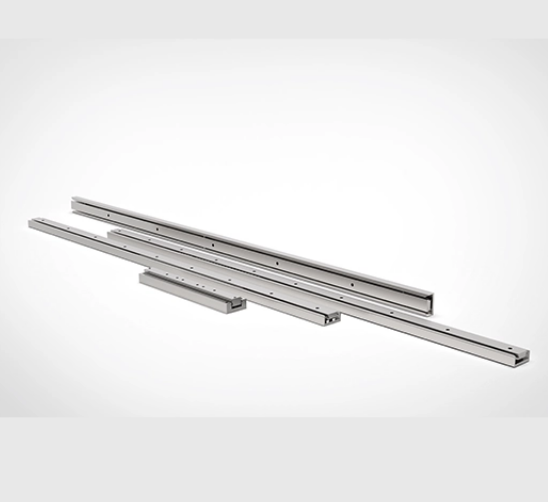
| Selecting the correct linear motion component is a critical engineering decision that dictates the longevity, accuracy, and cost-efficiency of your machine. While both components facilitate movement, choosing the wrong one often leads to system binding, premature wear, or significant budget overruns. Engineers and procurement managers must look past the basic function to understand the mechanical DNA of these components. To ensure we are on the same page, we must first clarify the terminology used across the industry. A "Guide Rod" is frequently called a linear shaft, round rail, or linear shafting. Conversely, a guide rail is often referred to as a profile rail, square rail, or linear guide. This article moves beyond simple definitions to provide a technical comparison for decision-makers. We will explore the nuanced differences in load mechanics, analyze the Total Cost of Ownership (TCO) for industrial applications, and define exactly where each component belongs in modern automation systems. Key Takeaways
1. Anatomy and Contact Mechanics: The Core Engineering DifferencesTo understand why performance varies so drastically between these two components, you must look at how the rolling elements interact with the track. The fundamental difference lies in geometry and contact area. Geometry and Contact AreaIn a linear rod system, the ball bushing rides on a round shaft. Because the shaft is convex and the balls are spherical, the interface is a single point of contact. This "Point Contact" creates high Hertzian stress concentration. Under heavy loads, this small contact area can lead to brinelling (permanent indentation) of the shaft surface. In contrast, a guide rail features raceways machined into a specific profile (often a gothic arch or circular arc). The rolling elements—whether balls or rollers—conform to this groove. This creates a "Line Contact" or "Arch Contact." By distributing the load across a significantly larger surface area, rails achieve superior stiffness. They also offer better vibration damping, which is critical for maintaining finish quality in machining applications. Structural IntegrationThe structural role of these components differs largely based on how they mount to the machine frame.
Anti-Rotation MechanicsA frequently overlooked mechanical constraint is rotation. A single round rod has no mechanism to prevent the bearing block from rotating around the shaft. To resist torque and maintain orientation, you must install two parallel rods. A single square rail, however, inherently constrains motion to one axis thanks to its profile. It can handle torque and moment loads independently, simplifying the design of compact assemblies. 2. Performance Limits: Precision, Rigidity, and SpeedWhen the application demands tight tolerances or high throughput, the gap between rods and rails widens. Understanding these performance limits is essential for calculating the error budget of your machine. Accuracy ProfilesIf your project requires positioning within micrometers, a high precision guide rail is generally the only viable option. Manufacturers grind these rails to strict tolerances, achieving accuracy levels as tight as ±0.01mm or better. The internal design of the carriage block allows for preload—oversized balls that eliminate internal clearance. Rods, by comparison, operate with looser tolerances. The ball bushings typically require a small amount of internal clearance to run smoothly without binding. This clearance translates to "play" or "slop" in the system. While acceptable for a woodworking jig or a gym machine, this backlash ruins repeatability in high-end optical inspection or semiconductor equipment. Load Capacity and Moment LoadsThe difference in load capacity is often described by the "10x Factor." Industry data consistently shows that a profile rail can handle up to 10 times the load of a linear rod of equivalent diameter. This is a direct result of the raceway design mentioned earlier. Furthermore, moment handling is a decisive factor. A linear carriage on a rail can support twisting forces (roll, pitch, and yaw) because of the contact angle of the bearings (usually 45°). A bushing on a round rod has almost no capacity to handle roll moments; it will simply rotate. For single-axis robotic arms or cantilevered loads, rails are indispensable. Speed and AccelerationModern automation system designs push for faster cycle times. Rails excel here. Because they are fully supported and rigid, they do not suffer from the "whipping" effect that long, unsupported rods experience at high speeds. High vibration in a rod system forces you to lower acceleration rates to prevent resonance. Rails allow for aggressive acceleration profiles, maximizing throughput without sacrificing stability. 3. The "Hidden" Costs: Installation Complexity vs. TCOThe price on the invoice is rarely the true cost of the component. Engineers must balance the upfront purchase price against the Total Cost of Ownership (TCO), which includes installation labor, maintenance, and downtime. Upfront Price vs. Long-Term ValueIt is an established fact that round rods are significantly cheaper to buy. You might save 20–40% on hardware costs initially. For a prototype or a low-budget hobbyist build, this is attractive. However, in an industrial setting, this calculation changes. Consider the context of high-cycle warehouse automation. If a sorting machine runs 24/7, the bushings on a linear rod will wear out much faster due to higher contact stress. Replacing these components requires stopping the line, disassembling the axis, and recalibrating. If a rail system lasts five years while a rod system requires bushing replacements every six months, the rail delivers a far lower TCO despite the higher initial price tag. Installation Realities: The "Compliance" TrapThis is where rods often win favor with design teams. Rails are "over-constrained" systems. Because they are so rigid, they require the mounting surface to be machined flat and parallel. If you bolt a high-precision rail to a warped welded frame, the carriage will bind immediately. The rail forces you to invest in precision machining of the base structure. Rods are "compliant." They are self-aligning to a degree. If your frame is made of unmachined aluminum extrusion or has slight welding distortions, a linear rod system can absorb that misalignment and still function smoothly. For non-precision structures, rods prevent the headache of binding. Maintenance IntervalsLubrication is the lifeblood of linear motion. Profile rail carriages often feature integrated oil reservoirs and sophisticated sealing systems (scrapers and wipers). These seals are highly effective at keeping grease in and contaminants out. Ball bushings on rods are often more open, making them susceptible to dust and requiring more frequent re-lubrication. In dirty environments, a rail block with a high-performance seal kit will outlast a standard linear bushing significantly. 4. Application Scenarios: When to Choose WhichTo synthesize the technical data, we can categorize common applications into three distinct scenarios. This helps streamline the selection process based on environmental and operational needs. Scenario A: Heavy Industrial and High PrecisionVerdict: Guide Rail In applications like CNC machining centers, semiconductor wafer handling, and high-speed linear motion system assemblies, rigidity is non-negotiable. Any deflection results in a rejected part. The high load capacity and moment control of guide rails make them the standard choice. The cost of precision mounting surfaces is justified by the performance gains. Scenario B: Cost-Sensitive or Light DutyVerdict: Guide Rod For applications such as the Z-axis of consumer 3D printers, adjustable gym equipment, or simple packaging diverters, the loads are light. Precision requirements are often in the millimeter range, not the micrometer range. Here, the compliance of the rod allows for cheaper frame materials, and the lower component cost fits the budget. Scenario C: Harsh Environments and WashdownsVerdict: Dependent on Material Food and beverage processing requires frequent washdowns. While both systems offer stainless steel options, chrome-plated shafting is widely available and cost-effective for rods. However, rails can be coated with dense chrome or black chrome treatments. The choice here often comes down to the geometry: rods are easier to wipe down and have fewer crevices for bacteria to hide compared to the complex profile of a rail track. 5. Sourcing Customization and Non-Standard RequirementsStandard catalog items cover 90% of applications, but the remaining 10% often define the competitive edge of a machine. Understanding when to go off-catalog is a hallmark of advanced engineering. Beyond the CatalogIn specialized environments, a standard carbon steel rail may fail. This is where non-standard guide rail options become critical. Manufacturers can apply special fluororesin coatings to resist corrosion or install high-temperature seals for foundry applications. Another common modification is butt-jointing, where rail ends are ground precisely to allow multiple rails to be joined for infinite travel lengths. Engineers looking to reduce assembly time often seek a customized guide rail solution. This might involve pre-tapped holes in non-standard locations, dowel pin holes for precise realignment, or carriages pre-loaded with specific cleanroom-grade lubricants. Sourcing these "ready-to-install" units reduces the burden on your assembly floor. Supply Chain ConsiderationsInterchangeability is a major logistical factor. Linear rails largely follow ISO standards for mounting dimensions. This means you can technically swap a rail block from one major brand to another (though mixing rails and blocks is generally discouraged due to preload variance). Rod systems are more generic. While the shaft diameter is standard, the mounting footprint of the pillow blocks can vary significantly between suppliers, potentially locking you into a single vendor. ConclusionThe choice between a guide rail and a guide rod is never about which component is objectively "better." It is about which component fits the error budget and the financial budget of your specific project. Rails offer rigidity, longevity, and precision for high-stakes automation. Rods offer forgiveness, simplicity, and cost-effectiveness for lighter, less critical tasks. Final Decision Matrix: FeatureGuide Rod (Linear Shaft)Guide Rail (Profile Rail)Primary AdvantageForgiving alignment & Low CostHigh Rigidity & PrecisionLoad CapacityLow (Point Contact)Very High (Line Contact)InstallationEasy (Self-aligning)Difficult (Needs flat surface)Ideal Use CaseLight bridging, simple pushersHeavy automation, CNC, RoboticsBefore finalizing your Bill of Materials (BOM), we recommend engaging with an application engineer to calculate the L10 load life of your chosen component. This calculation validates that your selection will survive the expected duty cycle of the machine. FAQQ: Can I replace a linear rod with a guide rail to stop vibration?A: Not always. If the vibration is caused by frame flex, a stiffer rail might actually transfer more vibration. However, rails generally reduce "ringing" due to tighter tolerances. Q: Which is easier to maintain: guide rail or guide rod?A: Rails are generally lower maintenance due to better sealing technologies (scrapers/wipers) that keep grease in and dirt out. Q: Are linear rails standard sizes?A: Yes, most industrial rails follow ISO standards for mounting hole dimensions and heights, though preload classes may vary between manufacturers. Q: Why does my linear guide rail bind?A: Usually due to misalignment. Unlike rods, rails cannot tolerate non-parallel mounting surfaces. Q: What is the price difference between guide rail and guide rod?A: A high-quality guide rail setup is typically 3x to 5x the cost of a basic round rod setup, but offers significantly higher load capacity and lifespan. |