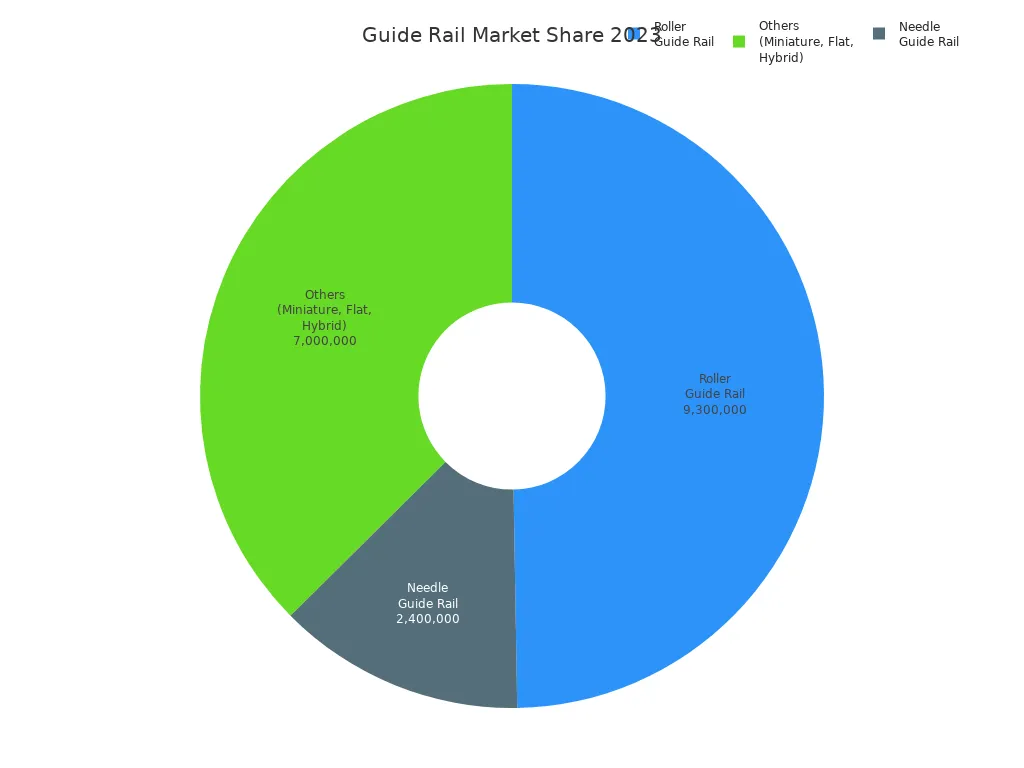
| You can find many kinds of guiding rails in factories and machines. The main types are linear rails like roller, ball, and cylindrical rails. There are also round rails, profile rails, dovetail rails, inlaid steel rails, and W-beam rails. Each guiding rail works best for certain weights and places. You must pick the right type for your job. For example, a roller guiding rail is good for fast and heavy work. A needle guiding rail is best when you need things to be very exact. The table below shows how often each guiding rail type was used : Type of Guiding RailUnits Deployed in 2023CharacteristicsRoller Guiding Rail9.3 millionHandles heavy loads, good for fast jobs, can take dynamic loads over 60,000 NNeedle Guiding Rail2.4 millionHas very little friction, very exact, used in medical and chip-making machinesOthers (Miniature, Flat, Hybrid)7 millionHas many types, hybrid rails are used in clean rooms
It is important to know the differences between each guiding rail. Picking the right one keeps your machines safe, working well, and lasting longer. Key Takeaways
Types of Linear RailsWhen you look at the types of linear rails, you see three main kinds. Each guide rail works in a special way. You need to know how each one moves and what jobs it does best. Ball Type Linear RailsBall type linear rails use small steel balls that roll between the rail and the runner block. This rolling action gives you smooth movement and high precision. You often see these linear guides in CNC machines and places where you need exact control.
Here is a table that shows the structure and uses of ball type linear rails compared to roller types: Rail TypeKey FeaturesApplicationsLinear Ball RailsRunner block with recirculating ball bearings, customizable raceway profilesCNC machining, semiconductor fabricationCrossed Roller RailsCylindrical rollers in alternating orientations, greater load capacityMedical imaging, wafer inspection, metrologyBall type linear rails have some strong points and some weak points. You can see them in the table below: Advantages of Ball Type Linear RailsDisadvantages of Ball Type Linear RailsHigh load-bearing capacityHigh cost compared to other systemsQuick and straightforward assemblyRequires extremely accurate mounting surfacesHigh machining precisionRunning qualities may feel less smooth or 'notchy'Quick runner paceMore susceptible to damage during shipping and assemblyYou get high load capacity and fast movement with ball type linear rails. You need to make sure the mounting surface is very flat. If you do not, the guide rail may not move smoothly. Ball type linear rails are more sensitive to bumps and knocks during shipping. Ball type linear rails use rolling friction. The friction coefficient is low, so you get less resistance when sliding. This makes them great for jobs where you need to move things quickly and with precision. Roller Type Linear RailsRoller type linear rails use rollers instead of balls. These rollers can be cylindrical or crossed. You get higher load capacity and better stability with this type of linear guide. You often use roller type linear rails in heavy-duty machines and places where you need to move big loads.
Here is a table that shows the load range for roller and ball linear guides: Linear Guide TypeSeriesBasic Dynamic Load RangeHeavy-Duty RollerRG11.3 kN - 275.3 kNHeavy-Duty BallWE5.23 kN - 29.8 kNSome precision linear guides can hold up to 419,000 N. You use roller type linear rails when you need to move heavy parts or when you want the guide rail to last a long time.
Roller type linear rails use rolling friction, just like ball types. You get smooth sliding and less wear. Cross guides with rollers can handle both heavy loads and precise movement. Cylindrical Linear RailsCylindrical linear rails use round shafts and bushings. You see this type of sliding rail in simple machines and places where you do not need high precision. The runner block slides along the shaft, sometimes with ball bearings inside the bushing. You get easy installation and low cost with cylindrical linear rails. You can use them in light-duty machines, 3D printers, and small automation setups. The sliding action can be smooth, but you may not get the same accuracy as ball or roller types.
Cylindrical linear rails use both sliding and rolling friction. If you use plain bushings, you get more sliding friction. If you use ball bushings, you get rolling friction and smoother movement. Comparing the Types of Linear RailsYou need to match the right guide rail to your job. Ball type linear rails give you high precision and fast movement. Roller type linear rails give you strength and stability. Cylindrical linear rails give you easy setup and low cost.
You can see that each type of linear guide has its own strengths. You need to think about load, speed, precision, and cost before you choose. Other Guiding RailsRound RailsRound rails are used in machines that need easy movement. These rails have a round shaft and a matching bushing or bearing. You can pick from wood, wrought iron, aluminum, fiberglass, or cable systems. The material you choose changes how long the rail will last. Wood can rot if it gets wet. Aluminum does not rust but is not strong for heavy loads. Marine-grade stainless steel cables are strong and last long in tough places. Round rails are good for light machines, 3D printers, and some gym equipment. Profile RailsProfile rails are also called square rails. They have a flat shape with sharp edges. You use them when you need to hold heavy loads and save space. These rails help make small machines strong. You must install them very carefully. They need to be lined up just right. Profile rails use special seals, so they may not keep out dirt as well. You see profile rails in robots, warehouse machines, and advanced linear guides.
Dovetail RailsDovetail rails have a wedge shape that locks moving parts in place. You use these rails for strong support and smooth sliding. Dovetail rails are found in machines that need careful lining up and steady movement. Machinery TypeUse Case DescriptionOptical SystemsHold lenses, mirrors, and detectors in labs with high accuracy.FirearmsAttach scopes and gear, making it easy to take them off and put them back on.Mechanical DevicesUsed where you need things lined up right and locked in place for smooth motion.You find dovetail rails in optical systems, firearms, and machines that need exact moves. Inlaid Steel RailsInlaid steel rails have a hard steel strip set into another material. This makes the rail tough and hard to wear out. You see these rails in big machines, embroidery tools, and sewing machines. These rails last a long time and can be used again and again. W-Beam and Bolt-On RailsW-beam and bolt-on rails are used for road safety. You see them on roads and highways to protect cars and people. W-beam rails have a wavy shape that helps take in hits. Bolt-on rails are easy to attach to posts or other things for fast fixing. AspectThrie Beam GuardrailsMaintenance RequirementsInstallation ComplexityNeeds careful ground work, post setup, rail mounting, and end piece fitting.Check often for straight rails, strong posts, good joints, and no rust.Maintenance FrequencyNeeded to keep the guardrail working well and lasting long.Check often to keep it safe, especially in tough weather.You need to check these rails often to keep them safe. W-beam and bolt-on rails are very important for road safety and act as strong barriers. Common Guide Rail Applications
Robotics and AutomationGuide rail systems are used a lot in robotics and automation. They help robots move on a set path with great accuracy. Factories use robot guide rails to control robots. Ground rails, also called the seventh axis, let robots do jobs like welding and casting. External axes help robots reach more places. Linear rails are important in these systems. They give a strong base and a moving part, often made of steel for strength. You can change linear guides for special needs, like making them lighter or stopping rust. Picking the right guide rail helps robots work faster and safer.
Industrial MachineryGuide rails are found in many industrial machines. These rails must handle heat, dust, and heavy things. Linear guides in these machines need good seals and must not wear out fast. Heavy-duty linear rails keep machines steady and stop breakdowns. Rolling parts in these rails lower stress, so machines last longer. Using the right guide rail makes machines work better and safer.
Material Handling and LogisticsGuide rail systems help move things safely and easily. Ball bearing guide rails are good for moving heavy things up and down. Roller guide rails work for many jobs and move smoothly. Cam roller systems move things fast and with care. These guide rails help move things quickly and safely, which is important for supply chains. They can hold over 1000 lbs and keep workers safe. Guide Rail SystemBest Use CaseBenefitBall bearing systemUp and down, heavy loadsSmooth, strong movementRoller systemCustom jobsSmooth, flexible movementCam roller systemFast, careful movesQuick, exact handlingSpecialized Equipment (e.g., embroidery, sewing, AGV, fitness)Many special machines use guide rails. Embroidery and sewing machines use inlaid steel rails for smooth moves. Automated guided vehicles (AGVs) use linear rails to travel straight in warehouses. Fitness machines use round rails for steady, quiet moves. Each guide rail fits the machine’s needs. Good guide rail setup keeps machines working well and stops accidents. Sometimes, guide rails also act as barriers to keep people safe.
You can see that guide rails are used in many industries. Choosing the right linear guide gives you better and safer results. Comparing Different Types of Guide RailsKey DifferencesIt is important to know how each guide rail works. Each type has a different shape and strength. Some rails carry more weight than others. Some rails are more exact. The table below shows how the rails are different: Type of Guide RailLoad Carrying CapacityPrecision LevelDurabilityBall Bearing Linear GuidesModerate loads, high speedVery highGood with proper careRoller Linear GuidesHeavy loads, strong impactsHighExcellentHardened Guide RailsVery heavy loads, stableModerate to highOutstandingPrecision Linear RailsVaries by sizeHighestGoodBall bearing linear guides move smoothly and quickly. Roller linear guides can hold bigger weights and do not shake much. Hardened guide rails are best for hard jobs and stay steady. Precision linear rails help you get the most exact moves.
Things like heat and wet air can change how rails work. You need to keep rails at the right temperature so they stay strong. Selection GuideThink about a few things before you pick a guide rail. Here is a checklist to help you choose:
Always pick the rail that fits your job. Good planning and care keep machines safe and working well. You can see many kinds of guiding rails. Each one has its own special features. The table below shows how they are different: FeatureLinear GuideCross Roller GuideLoad CapacityMediumHighPrecisionHighExtremely HighApplicationCNC, 3D printersMedical, precision toolsWhen you want to put in a guide rail, follow this checklist:
Always pick a rail that matches your machine. It is smart to ask experts for help. FAQWhat is the main purpose of a guiding rail?You use a guiding rail to control movement in machines. It keeps parts moving in a straight line or along a set path. This helps your machine work smoothly and safely. How do I choose the right guide rail for my machine?You should look at the weight your machine moves, the speed you need, and how exact the movement must be. Think about the work area and how much space you have. Can I use the same guide rail for different machines?You can use some guide rails in many machines, but not all. Always check the load, size, and type before you use a guide rail in a new machine. How do I keep my guide rails working well?
What happens if I pick the wrong guide rail?If you pick the wrong guide rail, your machine may not move right. It could break or wear out fast. Always match the rail to your needs for best results. |