
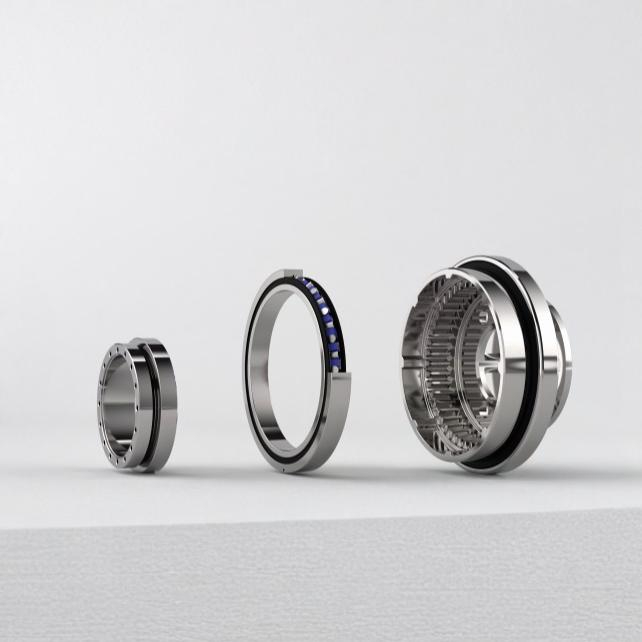
Humanoid robots require compact, lightweight, and highly precise transmission systems. Joint modules often contain new and unconventional mechanical structures, which place demanding requirements on bearing design, integration, and manufacturing accuracy. This page introduces our custom integrated bearing solutions that help robotics engineers achieve higher joint performance with reduced weight, smaller size, and increased reliability.
Industry Challenges |
Humanoid robots prioritize weight reduction and structural compactness. Every gram of joint mass affects energy consumption, stability, and operating endurance. At the same time, joint movement relies on accurate motion transmission, so any clearance, deformation, or accumulated tolerance directly reduces control precision. The industry also evolves quickly. Engineers continue to introduce unconventional designs, including non-standard hole positions, irregular outer profiles, multi-component integration, and compact joint layouts that have no existing bearing equivalents. These features require suppliers to deliver high engineering flexibility, fast response, and reliable customization capabilities. Root Causes and ImpactsHumanoid robot joints depend heavily on lightweight structures. Many joint housings adopt thin-wall geometries to reduce mass and help robots achieve longer operating time and better environmental adaptability. However, thin-wall components are difficult to machine. Their rigidity is limited, which makes it challenging to maintain dimensional accuracy. At the same time, joint modules require precise assembly fits. When multiple components are stacked, accumulated tolerances increase the risk of misalignment. This leads to several performance issues:
These impacts can weaken the robot’s dynamic performance and operational stability.
|
Our Engineering Solution |
We apply an integrated design approach that combines the bearing's inner and outer rings with surrounding structures such as reducers and mechanical housings. This reduces accumulated tolerance, increases structural rigidity, and lowers total weight while improving load capacity. With more than twenty years of custom bearing development experience, our team works closely with robotics engineers to turn conceptual designs into manufacturable solutions. Through deep involvement in early-stage development and our flexible production capability, we support research teams and product teams in bringing new humanoid robot ideas into reality. Performance AdvantagesBased on completed development projects, our integrated bearing solutions offer:
These advantages help manufacturers build lighter, more compact, and more durable robotic joints. |
|
|
Frequently AskedQuestions | What makes integrated bearings suitable for humanoid robot joints? Can you support irregular shapes or non-standard installation holes? How early should we involve your engineering team? Do you provide prototypes for new joint designs? What industries benefit from this type of bearing? |


