
Cross Roller Bearing Price: How Much Do They Cost and How to Buy Smarter?
Jun 05, 2026
BOM
_1780626804_WNo_1600d900.webp)
The price of a cross roller bearing tells you more than just what you'll pay — it reflects the precision, engineering, and application demands built into every unit. As global automation accelerates and industries from robotics to semiconductor manufacturing push tolerance boundaries tighter than ever, understanding what drives bearing costs has become a core procurement skill, not just a purchasing formality.
So how much do cross roller bearings actually cost? Based on publicly available market data and real supplier pricing, here's the short answer:
- Small models (20–40mm ID): $80–$180 for branded, $40–$90 from qualified Chinese manufacturers
- Medium models (50–100mm ID): $200–$500 branded, $100–$260 alternative
- Large and custom sizes (150mm+): $600 to $3,000+, depending on precision grade and specification
- Precision grade upgrades (P4/P2): add 30–150% on top of the base price
Whether you're an engineer selecting bearings for a robotic joint, a procurement manager comparing brand quotes, or an OEM designer optimizing component costs, this guide covers the six key pricing factors, a full brand comparison across THK, IKO, and HIWIN, and a practical framework for evaluating quotes — so you can make the right choice, not just the cheapest one. Read on to see exactly what you're paying for.
Table of Contents
- Why Cross Roller Bearings Cost More Than Standard Bearings
- 6 Key Factors That Determine Cross Roller Bearing Pricing
- How Much Do Cross Roller Bearings Actually Cost?
- IKO vs THK vs HIWIN: How Brand Choice Affects What You Pay
- 3 Procurement Variables That Quietly Push Up Your Total Cost
- Common Mistakes That Make Buyers Overpay
- How to Evaluate a Quote Before You Commit
- 5 Things to Check Before Choosing a Cross Roller Bearing Supplier
- Conclusion
Why Cross Roller Bearings Cost More Than Standard Bearings
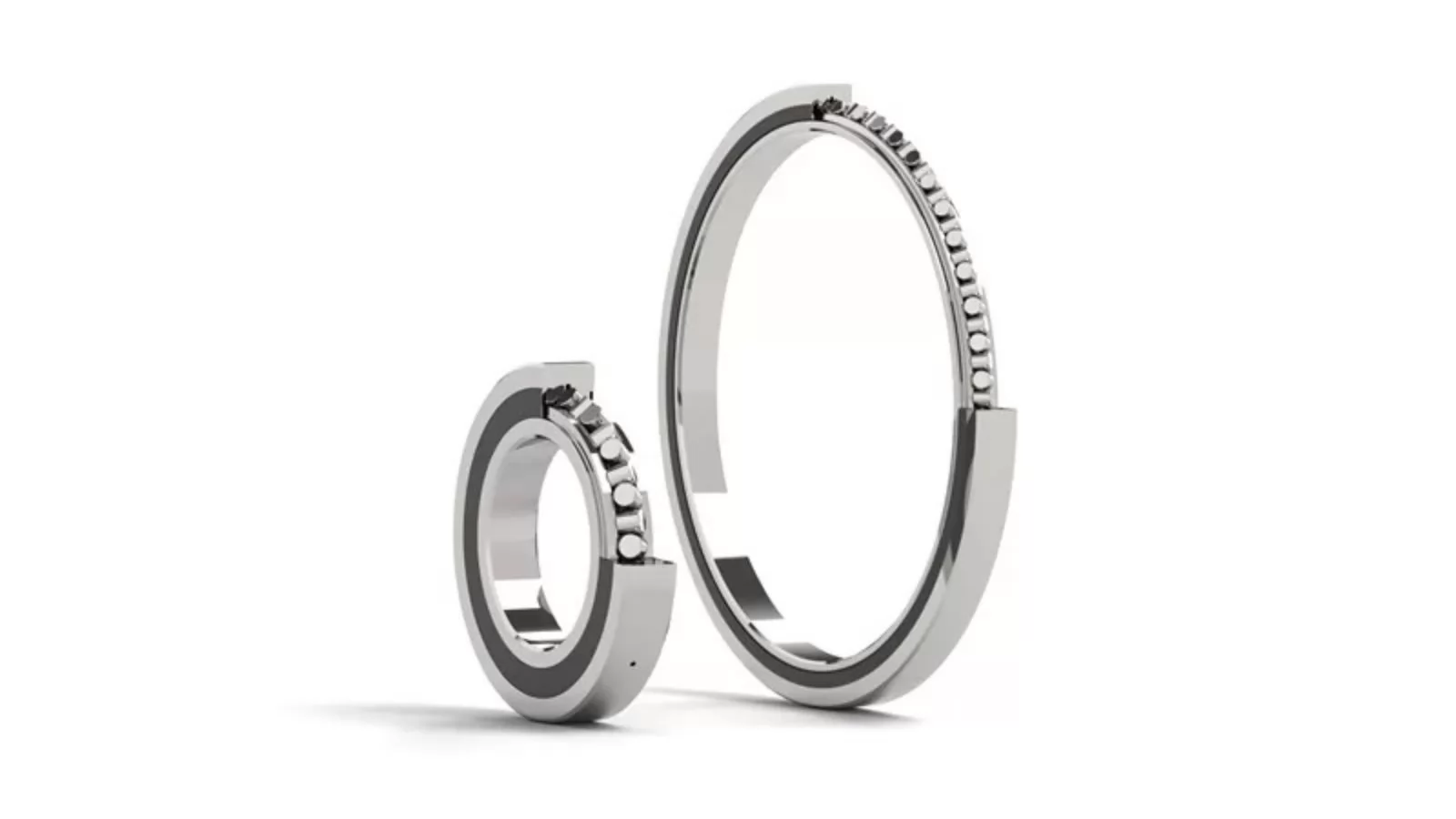
A standard deep groove ball bearing for a conveyor belt might cost $5. A cross roller bearing for a robotic joint can cost $500. Same physical size. Very different price. Why?
The answer is in what the bearing has to do.
One Bearing, Three Load Directions
A standard bearing handles one type of load well — usually radial. Add axial force or a tilting moment, and performance drops fast.
A cross roller bearing handles all three simultaneously:
| Load Type | Standard Ball Bearing | Cross Roller Bearing |
|---|---|---|
| Radial Load | ✓ Good | ✓ Excellent |
| Axial Load | △ Limited | ✓ Excellent |
| Moment Load | ✗ Poor | ✓ Excellent |
This multi-directional capability comes from a unique roller arrangement — cylindrical rollers alternating at 90° angles. That geometry is far more complex to manufacture than a row of identical balls.
Precision That Has to Be Measured in Microns
Think about a surgical robot guiding a needle inside a patient's body. Or a semiconductor lithography machine positioning a wafer to nanometer accuracy.
Both depend on cross roller bearings. Both demand rotational accuracy within a few microns — about 1/20th the width of a human hair.
Achieving that requires:
- Grinding tolerances held to ±1–2 μm
- Hardened steel raceways with surface finishes below Ra 0.1
- 100% dimensional inspection before shipping
That level of quality control adds time, equipment, and cost at every stage.
Real example: A 6-axis robotic arm joint uses a cross roller bearing rated at P4 precision. The same outer dimensions in a standard bearing cost $12. The P4 cross roller version: $380. The difference is entirely in manufacturing tolerance and inspection rigor.
Compact Form, Costly Engineering
Cross roller bearings replace what would otherwise require multiple separate bearings — a thrust bearing, a radial bearing, and a moment-load bearing stacked together.
One compact unit does the work of three. That engineering efficiency saves space and weight in the final machine. But consolidating that performance into a single ring demands significantly more from the designer and the manufacturer.
Less space to work with. More performance required. Higher cost to produce.
6 Key Factors That Determine Cross Roller Bearing Pricing
Not all cross roller bearings are priced the same — even within the same brand. Here are the six variables that move the number up or down most significantly.
1. Size and Dimensions
Bigger bearings need more raw material, longer grinding cycles, and heavier inspection equipment. The price scales non-linearly — doubling the diameter often triples the cost.
A small RB2008 (20mm ID) might cost around $80–$120. Scale up to an RB20025 (200mm ID), and you're looking at $600–$900 or more for the same series.
2. Precision Grade
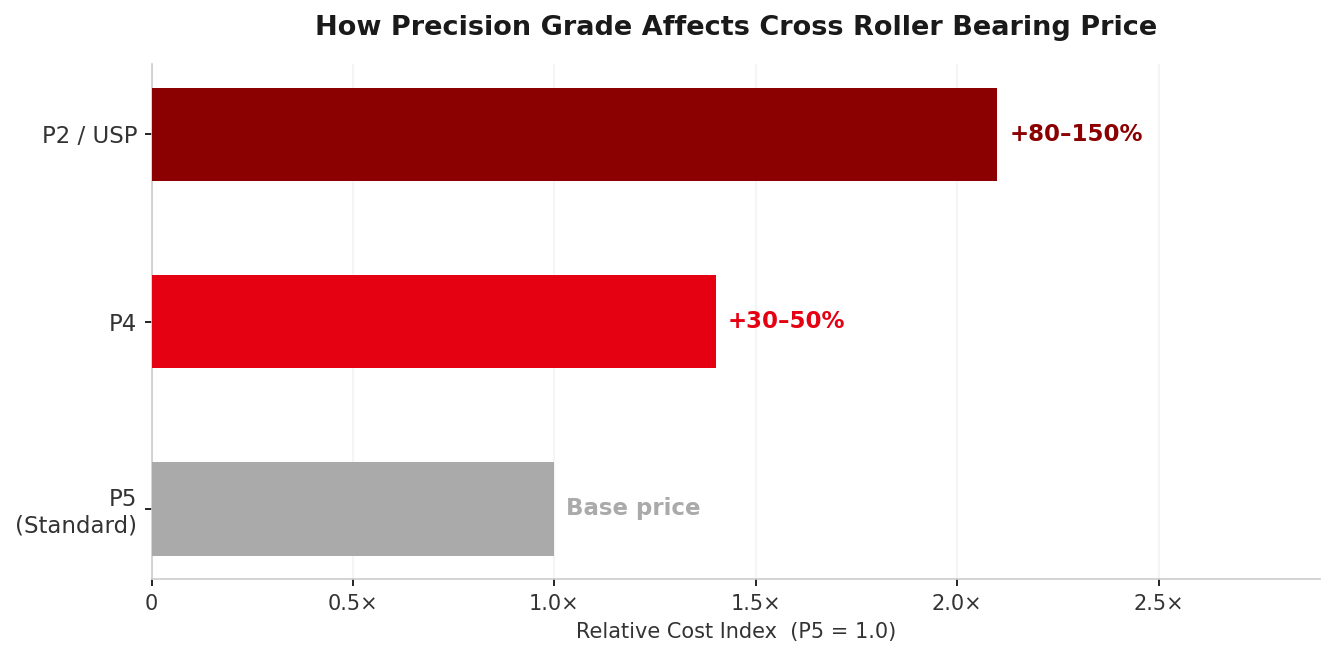
Precision grade is one of the biggest price jumps buyers don't anticipate.
| Grade | Runout Tolerance | Typical Price Premium | Common Application |
|---|---|---|---|
| P5 (standard) | ~5 μm | Base price | General automation |
| P4 | ~3 μm | +30–50% | Robotics, CNC rotary tables |
| P2 / USP | ≤1 μm | +80–150% | Semiconductor, medical imaging |
A buyer once ordered P2-grade bearings for a conveyor system — completely unnecessary for the application. They paid nearly double what P5 would have cost, with zero performance benefit.
3. Structural Type
The bearing's internal configuration directly affects manufacturing complexity.
- Full complement (no cage): more rollers, higher load capacity, but slower speeds — costs more to assemble
- Caged type: better for high-speed rotation, slightly lower cost
- Integrated ring (e.g. RU series): one-piece inner and outer ring — more rigid, more expensive to machine
- Separable ring (e.g. RB series): easier to install, lower manufacturing cost
4. Material and Surface Treatment
Standard bearings use GCr15 bearing steel. But some applications demand more.
- Stainless steel versions (for corrosive environments): +20–40%
- Ceramic hybrid rollers (for ultra-high speed or non-magnetic applications): +60–120%
- Special coatings (nitriding, black oxide): +10–25%
Example: A food processing plant needed corrosion resistance. Switching from standard steel to stainless added 35% to the bearing cost — but eliminated bearing replacements caused by washdown chemical exposure every 3 months.
5. Sealing and Lubrication
Open bearings are cheaper upfront. Sealed versions (with rubber or metal shields) cost more but protect against dust and reduce maintenance frequency. For harsh environments — outdoor machinery, CNC coolant exposure — the sealed premium pays back quickly.
6. Customization
Non-standard requirements add cost fast. Expect a 20–50% premium for:
- Custom mounting hole patterns
- Non-standard inner/outer diameters
- Special preload settings
- Modified width or cross-section
The more you deviate from catalog dimensions, the smaller the production batch — and the higher the per-unit cost.
How Much Do Cross Roller Bearings Actually Cost?
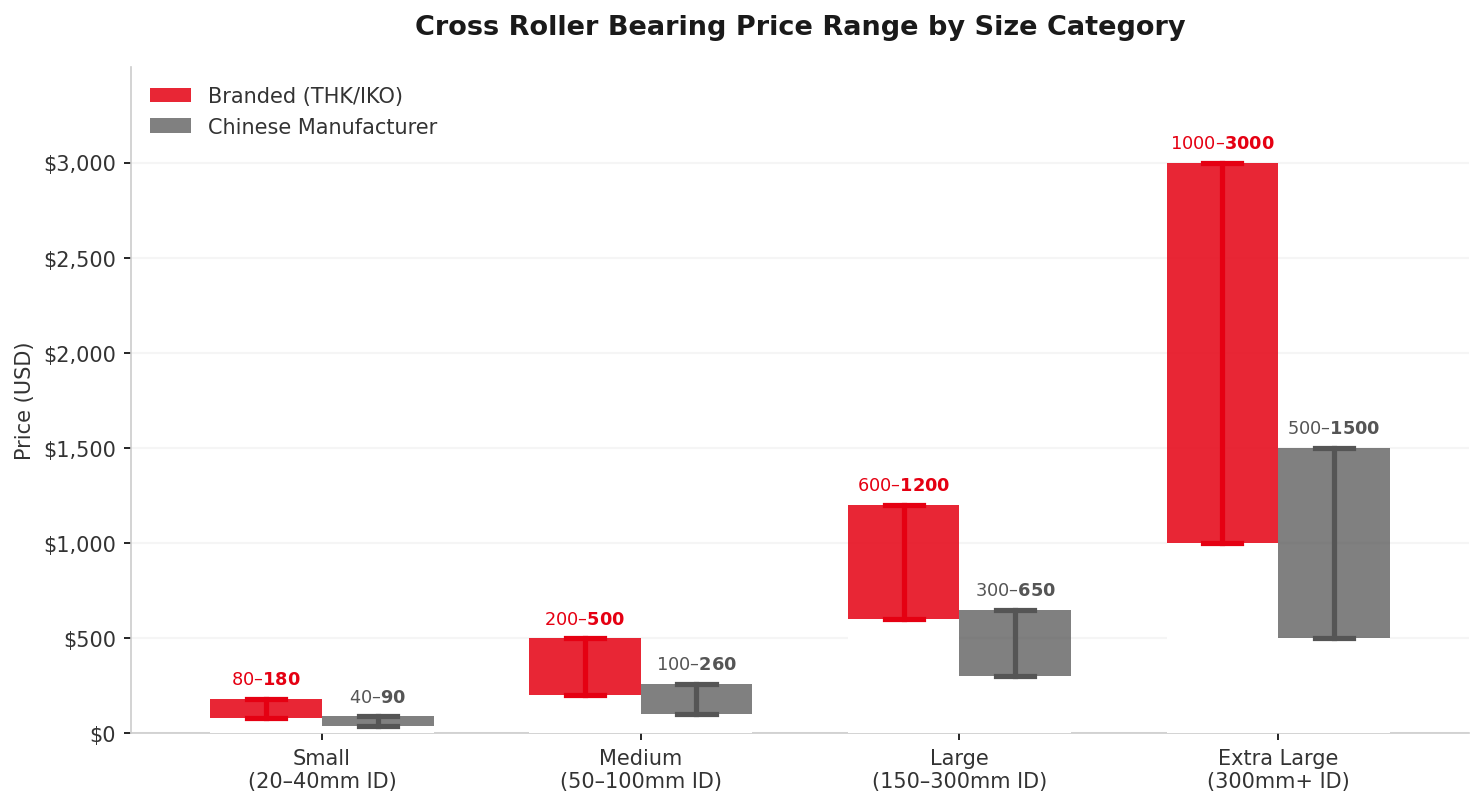
Here's the honest answer: cross roller bearing price ranges widely — from under $100 to well over $1,000. The key is knowing which size and grade category your application falls into.
The table below reflects market pricing based on common catalog models (P5 grade, standard steel, no customization). Branded (THK/IKO) figures represent typical retail/distributor pricing; Chinese manufacturer figures represent direct-purchase pricing from qualified suppliers.
| Size Category | Typical Model | ID Range | Branded Price (THK/IKO) | Chinese Manufacturer Price |
|---|---|---|---|---|
| Small | RB2008 / CRBC208 | 20–40mm | $80–$180 | $40–$90 |
| Medium | RB5013 / RB8016 | 50–100mm | $200–$500 | $100–$260 |
| Large | RB20025 / XU series | 150–300mm | $600–$1,200 | $300–$650 |
| Extra Large / Custom | SX / XSU series | 300mm+ | $1,000–$3,000+ | $500–$1,500+ |
Upgrading from P5 to P4 typically adds 30–50% to the base price. P2 or USP grade can double it.
What a Real Purchase Looks Like
A robotics engineer in Germany needs 20 units of RB8016 (P4 grade, sealed) for a new collaborative arm joint. Here's how the numbers break down:
Scenario: 20× RB8016, P4 grade, sealed
THK distributor quote: ~$420/unit → $8,400 total
Qualified Chinese manufacturer: ~$220/unit → $4,400 total
Savings: ~$4,000 on a single order — without changing the spec or the application performance.
When Price Should Not Be the Deciding Factor
Some applications genuinely require branded bearings — not because of performance, but because of certification or supply chain requirements. Aerospace, defense, and some medical device contracts specify approved vendor lists. If you're outside those constraints, the performance gap between a verified Chinese manufacturer and a Japanese brand is minimal for most industrial applications.
The question isn't "which is cheaper." It's "which delivers the right precision, in the right lead time, at the right total cost."
IKO vs THK vs HIWIN: How Brand Choice Affects What You Pay
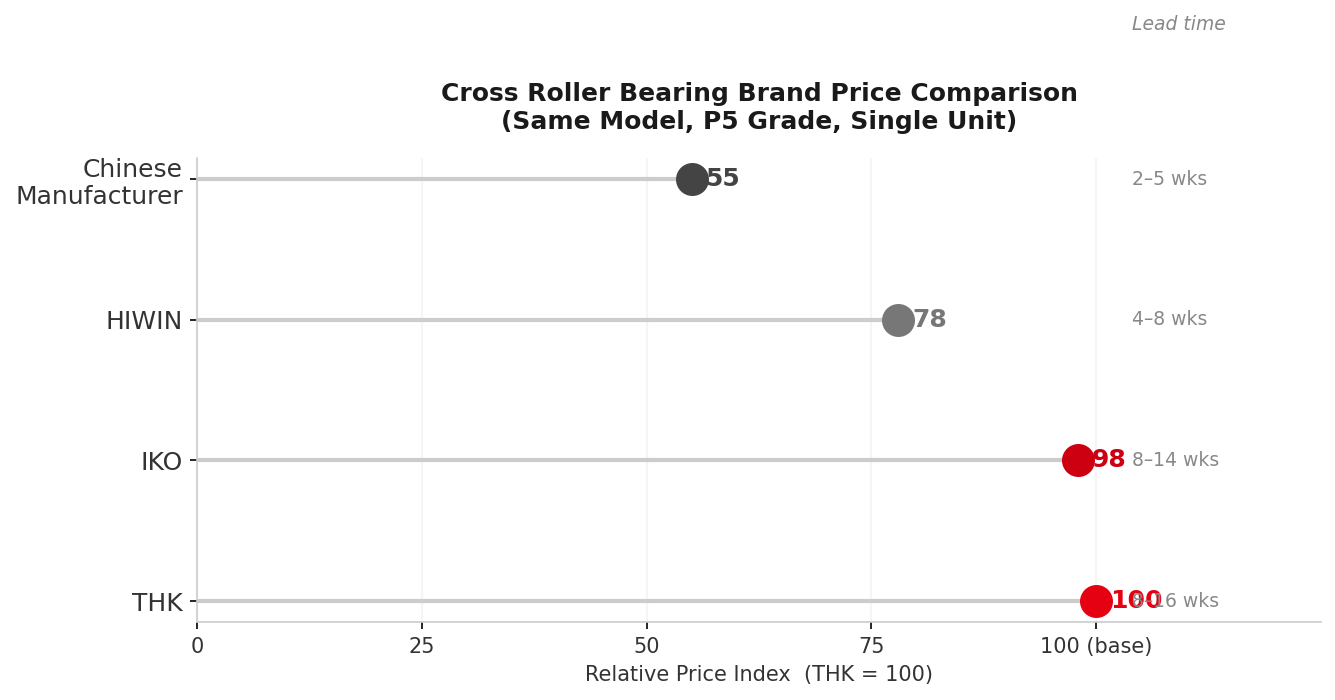
All three brands make excellent cross roller bearings. But they're not priced the same — and the differences go beyond the number on the invoice.
THK: The Market Standard
THK invented the crossed roller ring bearing. Their RB, RE, RU, and RA series cover virtually every industrial application. Broad catalog, strong global distributor network, well-documented load ratings.
That reputation carries a premium. THK bearings are rarely the cheapest option — but lead times from distributors are generally predictable, and technical documentation is thorough.
Best for: Engineers who need proven specs, fast distributor access, and minimal qualification risk.
Watch out for: 8–16 week lead times on non-stock sizes. Pricing is rarely published — you negotiate through distributors.
IKO: High-Rigidity Specialist
IKO's strength is compact, high-rigidity designs. Their CRBH series (integrated inner/outer ring) delivers exceptional stiffness in a smaller envelope — popular in machine tool spindles and precision rotary tables.
Pricing sits in a similar range to THK, sometimes slightly higher for the high-rigidity variants. Their slim CRBS and CRBT series are competitively priced but cover a narrower size range.
Best for: Applications where maximum rigidity per unit size matters — CNC spindles, measuring instruments.
Watch out for: Fewer catalog sizes than THK. Sourcing gets harder outside major industrial markets.
HIWIN: The Value-Positioned Brand
HIWIN is a Taiwanese manufacturer. Their CRBA, CRBB, CRBE, and CRBD series are direct equivalents to THK and IKO models — and are typically priced 15–25% lower than Japanese brands at distributor level.
Performance in standard applications is comparable. HIWIN has invested heavily in manufacturing precision and has a growing acceptance among European and American OEMs.
Best for: Cost-conscious buyers in automation, AGV, and mid-precision robotics who want a branded product with documented specs.
Watch out for: Less field history than THK/IKO in ultra-precision environments. Some distributor networks are thinner.
Brand Price Comparison at a Glance
Using a common reference model (equivalent to RB8016, P5, standard steel, single unit) as a benchmark:
| Brand | Origin | Relative Price Level | Lead Time (non-stock) | Typical Strength |
|---|---|---|---|---|
| THK | Japan | $$$$ | 8–16 weeks | Broadest catalog, proven track record |
| IKO | Japan | $$$$ | 8–14 weeks | High-rigidity compact designs |
| HIWIN | Taiwan | $$$ | 4–8 weeks | Cost-competitive, growing OEM acceptance |
| Chinese Manufacturers (qualified) | China | $$ | 2–5 weeks | Best price-to-performance for most applications |
For most industrial applications — robotics, automation, CNC rotary tables — a qualified Chinese manufacturer delivers equivalent dimensional and precision performance at 30–50% lower cost than Japanese brands.
3 Procurement Variables That Quietly Push Up Your Total Cost
The unit price is just one number. These three variables often matter more — and buyers miss them until it's too late.
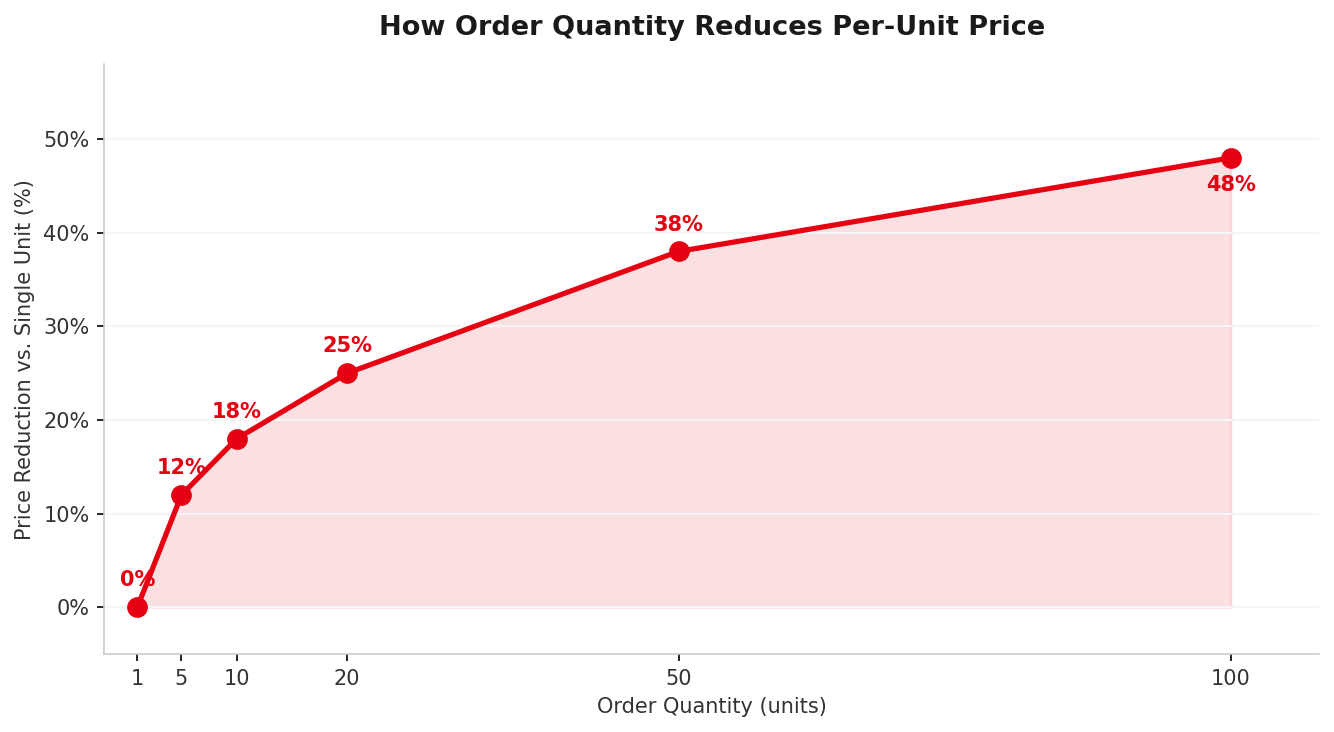
Variable 1: Order Quantity
Cross roller bearings are precision-manufactured in batches. Ordering one piece and ordering 50 pieces of the same model are very different transactions.
| Order Quantity | Typical Price vs. Single Unit |
|---|---|
| 1–2 pcs | Base (full price) |
| 5–10 pcs | –10 to –15% |
| 20–50 pcs | –20 to –30% |
| 100+ pcs | –35 to –50% |
If your production schedule allows it, consolidating orders — even across different models — can unlock meaningful savings.
Variable 2: Customization Creep
It starts small. A different hole pattern. A tighter preload. A non-standard width. Each change seems minor — but each one pulls the bearing out of standard production and into custom tooling territory.
Custom features typically add 20–50% to the base cost. More critically, they extend lead time from weeks to months and eliminate your ability to source from multiple suppliers.
Practical rule: Before requesting a custom spec, ask your engineer — can we redesign the mounting interface to fit a standard bearing instead? In most cases, the answer is yes, and the savings are immediate.
Variable 3: Lead Time and Expedite Costs
A bearing priced at $300 that takes 12 weeks to arrive can cost far more than a $380 bearing that ships in 2 weeks — when a production line is waiting.
Expedite fees from major brand distributors can add 20–40% to the invoice. Emergency air freight compounds it further. Buyers who lock in a supplier with short standard lead times avoid this trap entirely.
The total cost of ownership isn't just unit price × quantity. It's unit price + expedite risk + downtime exposure + incoming inspection cost + replacement frequency. Run that full calculation before comparing quotes.
Common Mistakes That Make Buyers Overpay
Most overpayment doesn't happen because buyers chose the wrong bearing. It happens because of decisions made before the purchase order was placed.
Mistake 1: Over-Specifying the Precision Grade
P4 costs 30–50% more than P5. P2 can cost double. If your application runs at moderate speed with no micron-level positioning requirement, P5 is enough.
A common scenario: an engineer specifies P4 "to be safe" on a rotary table that never exceeds 10 RPM under light load. The extra spend buys nothing measurable in the final machine.
Match the grade to the application requirement — not to the upper limit of what the budget can absorb.
Mistake 2: Single-Sourcing Without Leverage
Buying exclusively from one branded distributor feels safe. But without competitive quotes, you have no pricing leverage — and no backup when that distributor runs out of stock.
Qualifying a second supplier — even if you don't switch — gives you a benchmark for every future negotiation and protects your production schedule.
Mistake 3: Ignoring Total Cost of Ownership
A cheaper bearing that fails at 6 months costs more than a reliable one that lasts 3 years. The math is simple, but the temptation to optimize for invoice price alone is real — especially under budget pressure.
The right question isn't "what's the lowest price?" It's "what's the lowest cost per operating hour?"
Mistake 4: Not Verifying the Supplier
The cross roller bearing market has no shortage of listings from unverified sources — especially on B2B platforms. A bearing listed at 40% below market price with no inspection reports, no dimensional certificates, and no traceable production records is a liability, not a bargain.
Minimum verification checklist before placing an order:
- ISO 9001 certification (current, verifiable)
- Dimensional inspection report for your specific model
- Sample testing policy before bulk order
- Clear lead time commitment in writing
Price is easy to compare. Supplier reliability takes more work to evaluate — but it's where the real risk lives.
How to Evaluate a Quote Before You Commit
A quote is more than a number. Two quotes for the same bearing model can look identical on the surface — and deliver completely different outcomes. Here's how to read beyond the price line.
Check the Spec Match First
Before comparing prices, confirm the quoted bearing actually matches your requirement. These four parameters must align exactly:
| Parameter | What to Verify | Why It Matters |
|---|---|---|
| Model / Series | Exact model number, not just "equivalent" | Dimensional differences between series affect fit |
| Precision Grade | P5 / P4 / P2 stated explicitly | Grade affects both performance and price |
| Preload Class | C0 / C1 / C2 confirmed | Wrong preload causes early failure or poor rigidity |
| Sealing | Open / sealed / shielded specified | Sealed types cost more but protect in harsh environments |
A mismatched preload class is one of the most common — and costly — ordering errors. It doesn't show up until the machine is running.
Look at What the Quote Doesn't Say
Missing information in a quote is a signal, not an oversight. Ask for clarification on:
- Lead time: Is it in stock, or made to order? What's the confirmed ship date?
- Inspection documents: Is a dimensional report included, or available on request?
- Warranty terms: What's covered, for how long, and what's the return process?
- MOQ: Does the quoted price apply to your actual order quantity, or only to larger volumes?
Real scenario: A procurement manager received two quotes for RB6013 P4 — $290 and $370. He chose the lower price. The bearing arrived 11 weeks later (not the 3 weeks quoted), with no inspection report. The production delay cost more than the $80 saved per unit.
Calculate the True Landed Cost
Unit price is only the starting point. Before committing, add up:
- Shipping and freight (especially for international orders)
- Import duties and customs clearance fees
- Incoming inspection time and cost
- Payment terms (net 30 vs. full prepayment affects cash flow)
A bearing quoted at $200 FOB China with $40 freight, $18 duty, and 2 hours of incoming inspection can land at $290+ in real cost. A $230 quote with DDP shipping and a clean inspection report may actually be cheaper.
Ask for a Sample Before Bulk Commitment
For any new supplier, request one or two samples before placing a production order. A reliable supplier will agree without hesitation. Measure the bearing against the spec sheet. Check surface finish, marking clarity, and dimensional accuracy.
That $50 sample can prevent a $5,000 rework cost down the line.
5 Things to Check Before Choosing a Cross Roller Bearing Supplier
The bearing is only as reliable as the supplier behind it. Here's the checklist that separates dependable partners from risky ones.
1. Verified Precision Manufacturing Capability
Ask directly: what grinding and inspection equipment do they use? A credible precision bearing manufacturer should be able to tell you their machine tolerances, surface finish capabilities, and how they hold P4 or P2 grade consistency across a production batch.
Vague answers — "we use advanced equipment" — are a red flag. Specific answers — "we use Studer CNC grinding centers, 100% CMM inspection on precision grades" — indicate a real operation.
2. Quality Certifications That Are Current and Traceable
ISO 9001 is the baseline. But the certificate date matters. An expired or unverifiable certificate is worthless.
- Ask for the certificate number and issuing body
- Verify it independently on the certification body's website
- For high-precision applications, ask if they hold any application-specific approvals
3. Customization and OEM Capability
Even if your current order is standard, your next one may not be. A supplier with genuine non-standard production capability — modified dimensions, custom hole patterns, special preload — gives you room to grow without switching vendors mid-project.
Ask for examples of past custom orders. A capable supplier will have them readily available.
4. Lead Time Reliability — Not Just the Quoted Number
Any supplier can quote a short lead time. The question is whether they consistently hit it.
How to test this: Ask for references from existing customers in your region. Ask specifically about on-time delivery performance. A supplier who hesitates to provide references is telling you something important.
5. After-Sales Support and Technical Response
Cross roller bearings occasionally arrive with questions — a dimensional discrepancy, an installation query, an unexpected noise in operation. How fast does the supplier respond? Do they have engineers who can answer technical questions, or only sales staff who escalate everything?
Send a technical question before you place an order. The quality and speed of the response tells you exactly what post-purchase support will look like.
| Checklist Item | What to Ask | Green Flag | Red Flag |
|---|---|---|---|
| Manufacturing capability | What equipment and tolerances? | Specific machines, CMM inspection | Vague or evasive answers |
| Certifications | ISO number and issuing body? | Current, verifiable certificate | Expired or unverifiable |
| Customization | Past custom order examples? | Documented examples available | No examples, vague claims |
| Lead time | Customer references for on-time delivery? | References provided willingly | Hesitation or deflection |
| Technical support | Send a pre-sale technical question | Fast, specific, engineer-level response | Slow, generic, or sales-only reply |
Finding the right supplier takes more effort upfront. But a reliable partner — one with the right precision capability, honest lead times, and real technical support — reduces your total procurement risk far more than chasing the lowest unit price.
Conclusion
Cross roller bearing pricing is rarely straightforward — it's shaped by a combination of size, precision grade, structural type, brand positioning, and procurement decisions that compound quickly. A bearing that looks identical on paper can cost three times as much depending on who made it, what grade it's built to, and how urgently you need it. The buyers who consistently get the best value aren't always the ones who find the lowest unit price — they're the ones who understand what they're actually paying for and match the specification to the real demands of their application.
If you're sourcing cross roller bearings and need a supplier that combines manufacturing precision with competitive pricing and reliable lead times, BOM Bearing is a China-based precision bearing manufacturer with deep experience supplying engineers and OEMs worldwide. From standard catalog models to custom specifications, BOM provides verified quality, transparent pricing, and the technical support to get your procurement right the first time. Visit www.bom-bearing.com to request a quote or discuss your specific requirements.


Hot Article
-
Top 10 Chinese Bearing Brands: How to Choose?
-
Top 10 Custom Ball Bearing Factories in the USA 2026
-
Top 10 Bearing Brands in the World: 2026 Rankings
-
Top 10 Ball Bearing Manufacturers & Suppliers in China 2026
-
Top 10 Slewing Ring Bearing Manufacturers and Suppliers in China (2026)
-
Top 10 Roller Bearing Suppliers in China (2026)
-
Top 10 Cross Roller Bearing Manufacturers 2026
-
List of Custom Bearing Manufacturers: Our Top 10 Picks
Speak to One of Our Experts
Name can't be empty
Email error!
Message can't be empty
Send Message
*We respect your confidentiality and all information are protected.
People Also Viewed
-
 Top 10 Chinese Bearing Brands: How to Choose?
Looking for the best Chinese bearing brands? This guide reviews the top 10 bearing manufacturers in China — covering certifications, product range, and application fit — to help distributors, engineers, and procurement teams source the right bearing supplier with confidence.
Read More -
 Top 10 Ball Bearing Manufacturers & Suppliers in China 2026
Below you'll find profiles of ten verified ball bearing manufacturers and suppliers in China — each selected for export track record, product depth, and accessibility for international buyers.
Read More -
 5 Best Bearing Units Manufacturers in the USA 2026
Explore 5 leading bearing unit manufacturers serving the U.S. market in 2026, with key products, applications, and practical buying factors for OEMs, MRO teams, distributors, and industrial buyers.
Read More


