
Linear Bearing & Guide Rail Prices: What You Should Know Before Buying in 2026
Jun 11, 2026
BOM
Whether you're sourcing linear bearings for a 3D printer build or evaluating linear guide rail prices for an industrial CNC system, one thing is clear: the market has never offered more options — or more ways to get it wrong. With the global linear motion market valued at over $3 billion in 2024 and growing steadily, procurement decisions that once took weeks are now made in minutes, often without the context needed to avoid costly mistakes.
This guide cuts through the noise. Here's what you actually need to know before placing an order:
- Linear bearing prices range from under $1 to $80+ per unit — and size is only part of the story
- Linear guide rail systems span $30 hobby kits to $2,000+ industrial setups from THK or HIWIN
- Precision grade, material, and brand tier drive price differences far more than most buyers expect
- ISO-certified Chinese manufacturers now offer profiled rails at 30–50% below Japanese and Taiwanese equivalents
This guide is written for engineers, procurement managers, and machine builders — anyone who needs to make a confident, cost-effective decision on linear motion components.
From entry-level round-shaft systems to high-precision profiled guide rails, understanding the difference between product types, brands, and accuracy grades is the foundation of a smart purchase. Read on to find the right fit for your application and budget.
Table of Contents
- Linear Bearings vs. Linear Guide Rails: Are They the Same Thing?
- What Does a Linear Bearing Actually Cost?
- Linear Guide Rail Pricing: From Entry-Level to Industrial Grade
- What Drives the Price Difference?
- Brand Comparison: Premium vs. Value Options
- How to Get the Best Price Without Sacrificing Quality
- Frequently Asked Questions
Linear Bearings vs. Linear Guide Rails: Are They the Same Thing?
Short answer: no. But the confusion is everywhere — even some suppliers use the terms interchangeably. Here's what actually sets them apart.
Linear Bearings: The Round-Shaft World
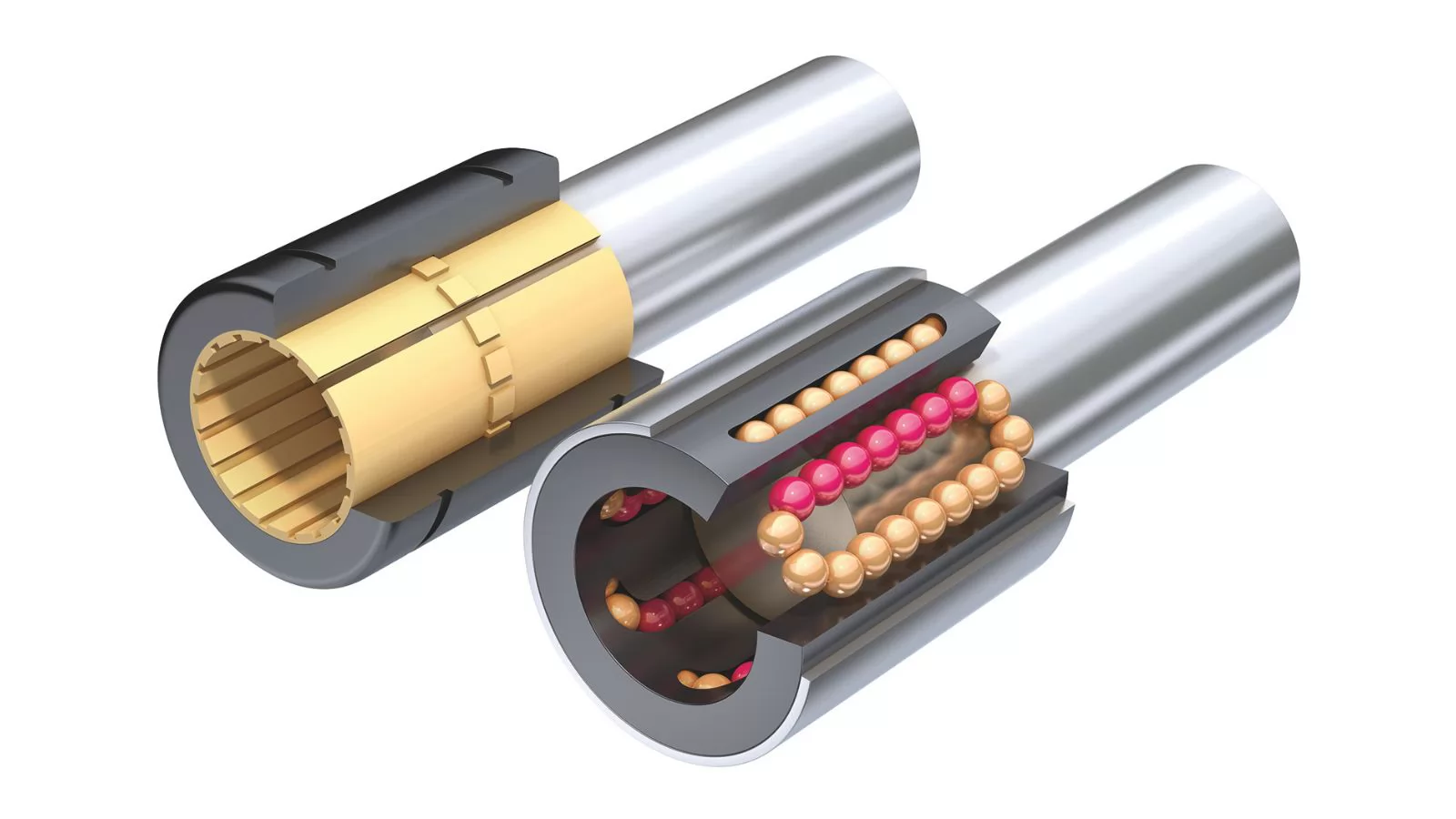
Picture a 3D printer. That small metal sleeve gliding along a smooth steel rod? That's a linear bearing — specifically something like an LM8UU.
It's compact. It's affordable. It clicks onto a round shaft and moves on recirculating steel balls — a design that keeps friction low and cost even lower.
Need something with higher load capacity and less play? A linear cross roller bearing uses crossed cylindrical rollers instead of balls, delivering noticeably better rigidity on the same round-shaft setup.
Linear Guide Rails: The Profiled-Rail World
Now picture a CNC machining center cutting aluminum at high speed. The table needs to move with near-zero play, absorb cutting forces, and repeat positions to within microns.
A round shaft bearing won't survive that environment.
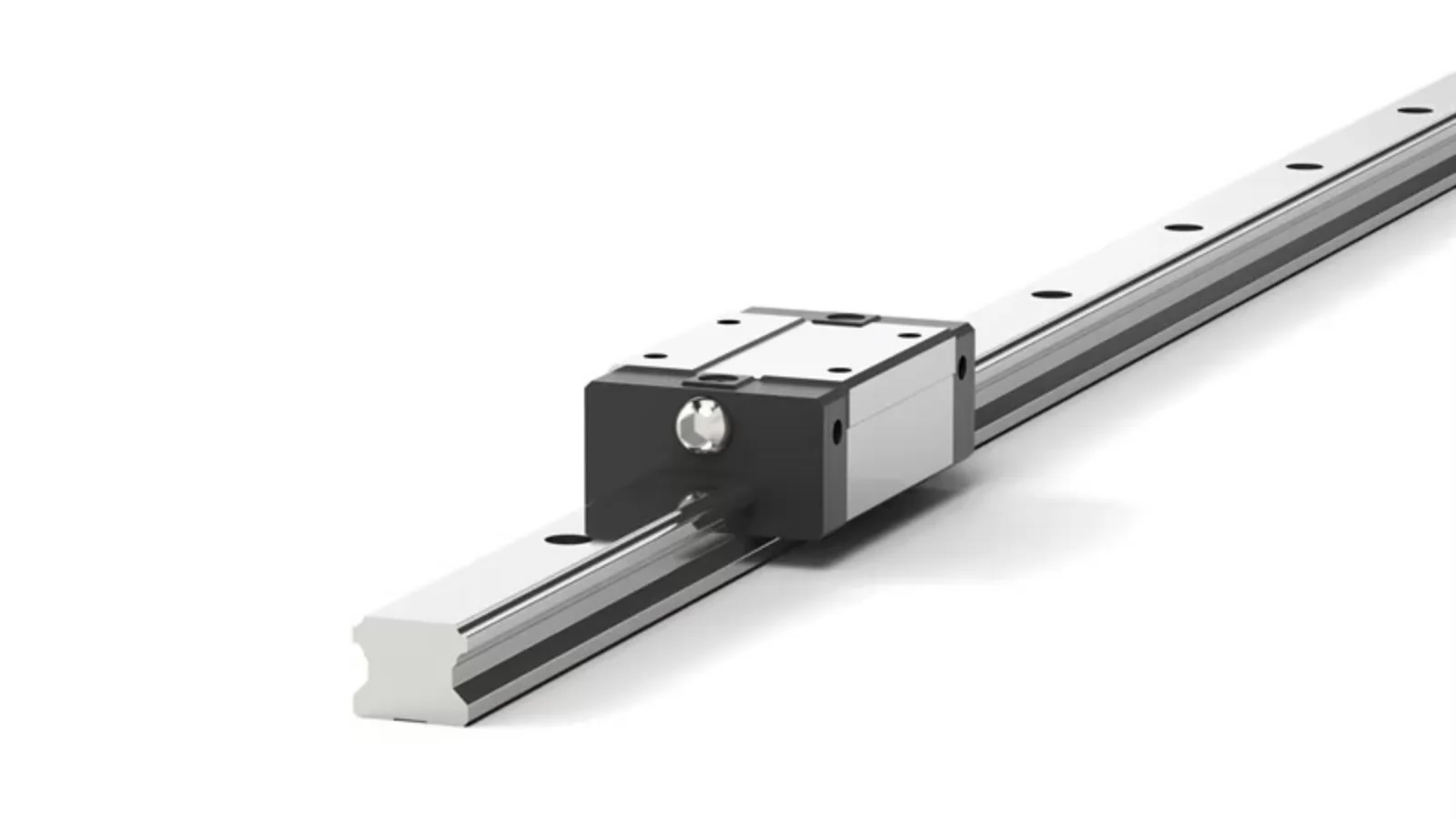
That's where a linear guide rail system comes in — a hardened steel rail with a precision-ground profile, paired with a matching carriage block. Think HIWIN HGR20 or THK HSR15.
The carriage block is the part that actually moves. It houses the rolling elements inside, rides along the rail, and transfers load directly into the machine frame — giving the whole system its rigidity.
The difference becomes obvious the moment you hold both in your hands — one fits in your palm, the other belongs bolted to a machine frame.
Why Do People Confuse the Two?
Search for "linear guide bearing price" and you'll find results mixing both product types freely.
Part of the reason: many guide rail systems include bearing elements inside the carriage block. So technically, a guide rail system contains linear bearings — just not the round-shaft kind.
The result? Overlapping terminology, blurry product listings, and buyers who aren't sure what they actually ordered until the package arrives.
Here's how the two compare across the specs that matter most.
| Linear Bearing | Linear Guide Rail | |
|---|---|---|
| Runs on | Round shaft | Profiled rail |
| Rolling element | Recirculating balls or cross rollers | Balls or rollers inside carriage block |
| Typical accuracy | Moderate | High to ultra-high |
| Rigidity | Lower | High |
| Load capacity | Light to medium | Medium to heavy |
| Price range | $2 – $50 per unit | $50 – $2,000+ per set |
| Common example | LM8UU, LM12UU | MGN12, HGR20, SBR16 |
| Best for | DIY, light automation | Industrial, precision machines |
Both solve the same fundamental problem — guided linear motion — just at very different levels of precision and cost.
What Does a Linear Bearing Actually Cost?
For most buyers, this is the first question. The good news: linear bearings are one of the most affordable motion components on the market.
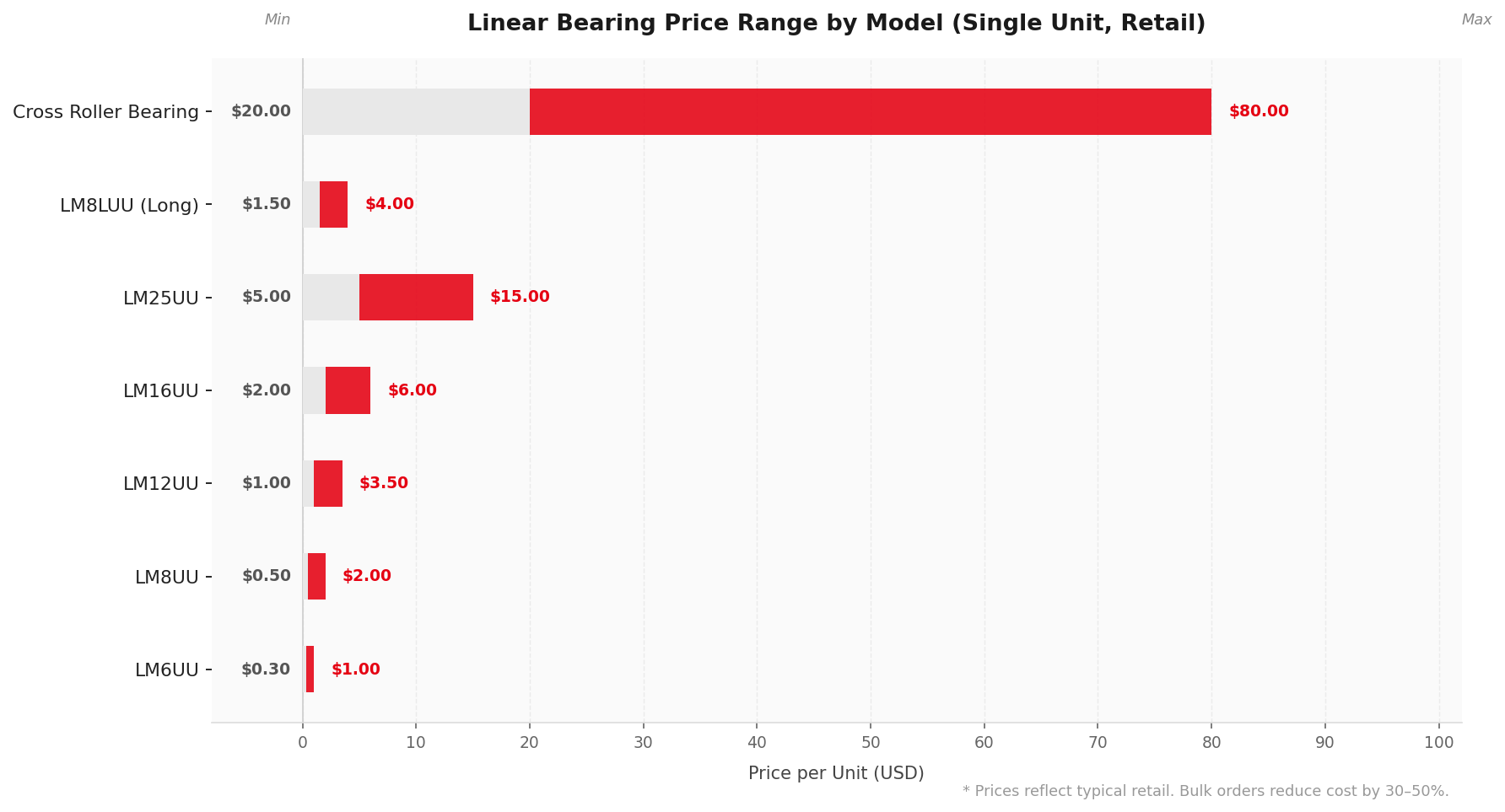
A single LM8UU — the workhorse of 3D printers and light CNC builds — typically runs $0.50 to $2 per piece when bought individually. Order a pack of 12 and the per-unit cost drops further.
Step up to larger sizes like LM25UU or LM30UU, and you're looking at $5 to $20 each. Need a sealed, long-type variant (LM8LUU) for extended travel? Expect a small premium over the standard version.
Price Reference by Series
Prices below reflect typical single-unit retail. Bulk orders from suppliers can reduce costs by 30–50%.
| Model | Bore | Type | Typical Price (each) |
|---|---|---|---|
| LM6UU | 6mm | Standard | $0.30 – $1.00 |
| LM8UU | 8mm | Standard | $0.50 – $2.00 |
| LM12UU | 12mm | Standard | $1.00 – $3.50 |
| LM16UU | 16mm | Standard | $2.00 – $6.00 |
| LM25UU | 25mm | Standard | $5.00 – $15.00 |
| LM8LUU | 8mm | Long type | $1.50 – $4.00 |
| Linear cross roller bearing | varies | High rigidity | $20 – $80+ |
One thing to watch: the price gap between a generic bearing and a name-brand one (SKF, IKO, THK) can be 3–5x. For a 3D printer, the generic works fine. For a medical device or semiconductor machine, that price difference buys you traceable tolerances and documented load ratings.
Linear Guide Rail Pricing: From Entry-Level to Industrial Grade
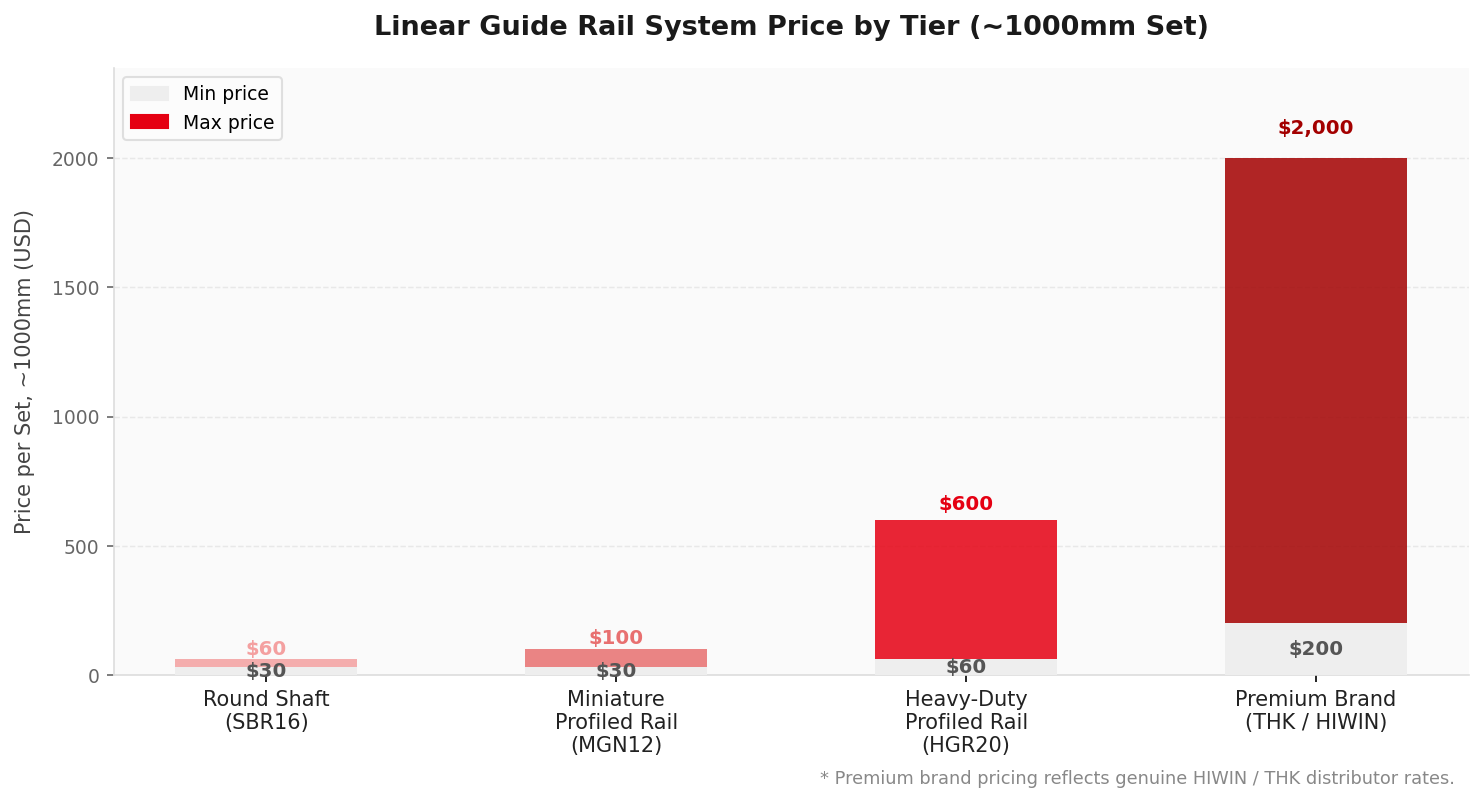
Linear guide rail pricing has a much wider spread than linear bearings — and the difference isn't just brand markup. It reflects real engineering gaps in precision, rigidity, and lifespan.
Entry-Level: Round Shaft Systems (SBR Series)
The SBR16 is the gateway drug of linear motion. Two supported rails plus four bearing blocks, 1000mm long — around $30 to $60 a set.
It's not the most precise system, but it's easy to align, widely available, and cheap enough to experiment with. Popular for DIY CNC routers, laser cutters, and basic automation frames.
Mid-Range: Miniature Profiled Rails (MGN Series)
The MGN12 is where serious hobbyists and small machine builders land. A 300mm rail with one carriage block runs $15 to $30 from a reliable Chinese supplier — or around $40–$60 for a genuine HIWIN unit.
These compact linear motion rails and blocks deliver far better accuracy than SBR systems and take up much less space. They've become the default choice for modern 3D printer upgrades and small CNC builds.
Industrial Grade: Heavy-Duty Profiled Rails (HGR Series)
A pair of HGR20 rails at 1000mm with four carriage blocks runs $60 to $100 from Chinese manufacturers — and $300 to $600+ from HIWIN or THK distributors.
The industrial-grade systems aren't just more precise. They come with published accuracy grades, preload classes, and load ratings you can actually engineer around.
Here's how the three tiers compare on price and performance.
| Type | Example | Price (set, ~1000mm) | Best For |
|---|---|---|---|
| Round shaft (SBR) | SBR16 | $30 – $60 | DIY CNC, laser cutters |
| Miniature profiled rail | MGN12 | $30 – $100 | 3D printers, small CNC |
| Heavy-duty profiled rail | HGR20 | $60 – $600+ | CNC machining, industrial automation |
| Premium brand (THK/HIWIN) | HSR25 / HGR25 | $200 – $2,000+ | Semiconductor, medical, aerospace |
The jump from mid-range to premium isn't just about the name. Premium rails come with tighter tolerance grades, better surface finishes, and — crucially — documentation that holds up in a regulated industry audit.
What Drives the Price Difference?
Two linear guide rails can look identical on a product listing — same dimensions, same model number — and cost 5x apart. Here's what's actually behind that gap.
Material and Steel Grade
Most rails are made from high-carbon steel or alloy steel. The difference shows up in the details: how the steel was sourced, its purity, and whether it was properly heat-treated.
Stainless steel variants cost more — but they're the right call for food processing lines, pharmaceutical equipment, or anywhere moisture is a constant problem.
Precision Grade
This is the single biggest cost driver most buyers overlook.
Linear guides are graded from Normal (N) through High (H), Precision (P), Super Precision (SP), and Ultra Precision (UP). Each step up tightens the tolerances — and raises the price by 10–25% per grade.
For a general automation frame, Normal grade is fine. For a semiconductor wafer handler that repeats to ±1 micron, you need UP — and you'll pay for it.
Size and Load Capacity
Straightforward: bigger rails need more material and more machining time. A 15mm profiled rail costs less than a 25mm one. A 1000mm rail costs less than a 2000mm one.
Roller-type linear guides — which use line contact instead of ball contact — carry significantly heavier loads and cost more than equivalent ball-type systems.
Manufacturing Process
Precision grinding is expensive. A rail ground to tight tolerances requires slow, multiple-pass machining on high-end equipment. Cheaper rails skip this — and the surface finish tells the story the moment you run a carriage along them.
Heat treatment is the other dividing line. Proper case hardening gives a rail its wear resistance. Cut corners here and you get a rail that looks right but wears out in a fraction of the expected lifespan.
Customization and Non-Standard Sizes
Standard lengths ship from stock. Custom lengths, special mounting patterns, or non-standard preload classes all add lead time and cost. If your design requires something off-catalogue, budget accordingly.
Brand Comparison: Premium vs. Value Options
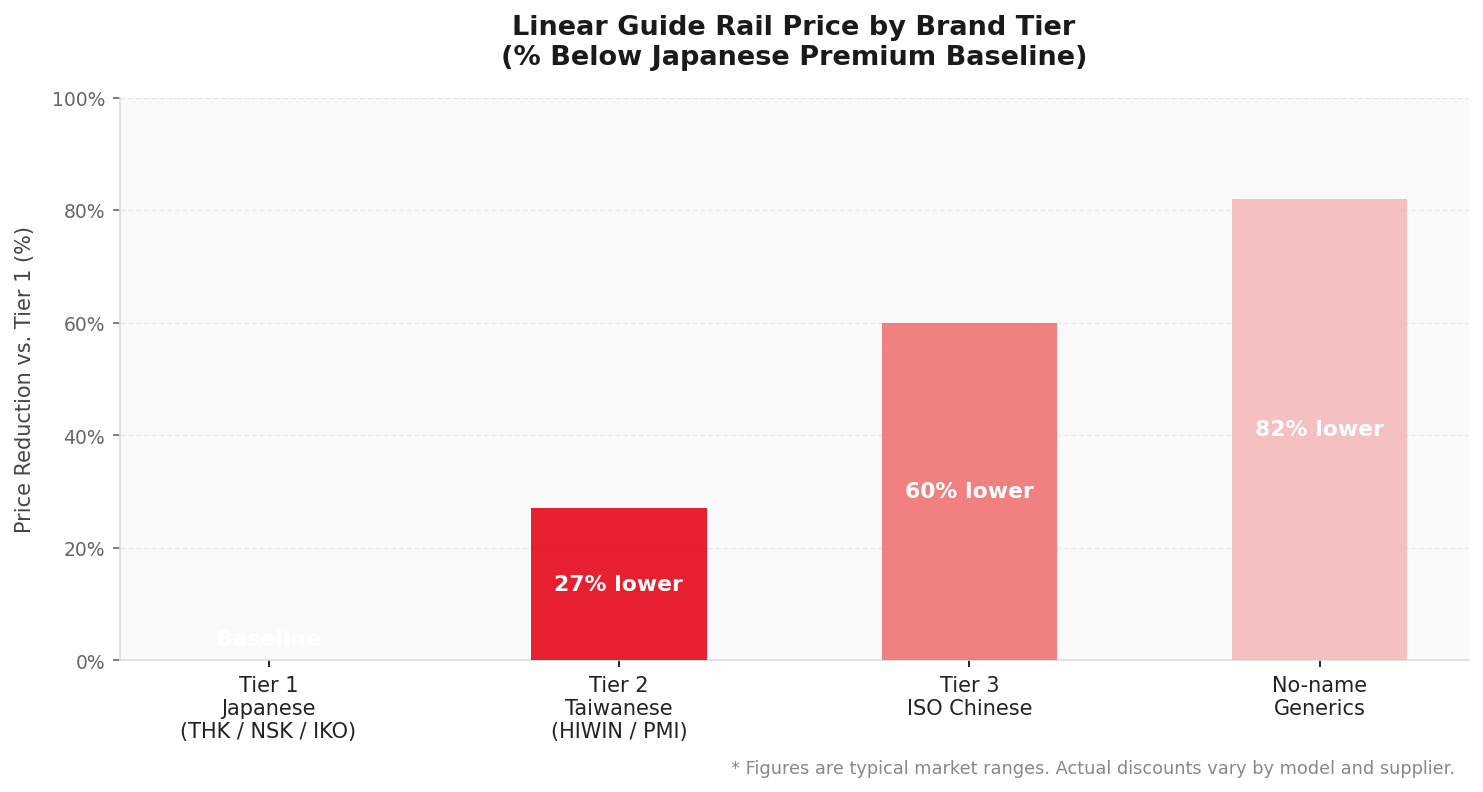
The brand you choose matters — but not always in the way people expect. Here's an honest look at the landscape.
Tier 1: Japanese Precision Brands
THK, NSK, IKO — these are the names that appear in aerospace specs, semiconductor fab equipment, and medical device datasheets. They've been setting the standard for linear motion since the 1970s.
THK invented the recirculating ball linear guide as we know it. NSK is the go-to in precision metrology. IKO dominates crossed roller and miniature guide applications where standard ball guides simply can't deliver the rigidity needed.
Price reflects this. A THK HSR25 carriage block runs $150–$300+. You're paying for documented tolerances, traceability, and decades of application engineering behind every part number.
Tier 2: Taiwanese Brands
HIWIN is the name most engineers reach for when they want Japanese-level quality at a more manageable budget. Roughly 20–35% cheaper than THK, with accuracy grades and load ratings you can actually engineer around.
For CNC machine tools, industrial robots, and automation systems, HIWIN is the practical sweet spot. It's also the most-copied brand on the market — which means buyer caution is warranted on platforms like AliExpress and Amazon.
Tier 3: ISO-Certified Chinese Manufacturers
This is where the real value conversation happens. Reputable Chinese manufacturers — those with ISO 9001 certification and published accuracy specs — now offer profiled rails at 30–50% below HIWIN pricing.
For general industrial automation, non-critical machinery, and cost-sensitive projects, this tier delivers acceptable and often excellent performance. The key word is reputable: ask for spec sheets, check certifications, and avoid sellers who can't provide dimensional tolerances in writing.
Here's how the tiers stack up in practical terms.
| Brand Tier | Examples | Price vs. THK | Best For |
|---|---|---|---|
| Tier 1 — Japanese | THK, NSK, IKO | Baseline | Semiconductor, medical, aerospace |
| Tier 2 — Taiwanese | HIWIN, PMI | 20–35% lower | CNC machines, industrial automation |
| Tier 3 — ISO Chinese | Various certified | 50–70% lower | General automation, cost-sensitive builds |
| No-name generics | — | 80%+ lower | DIY, prototyping only |
The right choice isn't always the most expensive one. A $15 generic MGN12 rail running at low speed on a 3D printer is perfectly reasonable. That same rail on a production CNC spindle is a liability.
How to Get the Best Price Without Sacrificing Quality
Smart buying isn't about finding the cheapest option. It's about matching the right product to the right application — and not overpaying for performance you don't need.
1. Match Precision Grade to Your Application First
This is where most buyers either overspend or underbuy.
A DIY CNC router doesn't need SP-grade rails. A semiconductor pick-and-place machine can't run on Normal grade. Define your actual tolerance requirements before shopping — it's the fastest way to avoid paying for precision you'll never use.
2. Negotiate Volume Discounts
Linear guide pricing has steep volume gradients. Orders over 100 units typically unlock 15–40% discounts across most suppliers. At 500+ units, that range extends to 35% or more.
Even if you don't need 100 units today, it's worth asking about tiered pricing — many suppliers will honor volume rates if you commit to a blanket order over a quarter.
3. Get Quotes from at Least Three Suppliers
The same HGR20 rail at the same spec can vary by 40–60% between distributors. Spend 20 minutes sending three RFQs. The price gap you find will justify every minute of it.
For ISO-certified Chinese manufacturers, ask specifically for: accuracy grade documentation, material certification, and MTBF data. If a supplier hesitates on any of these, that's your answer.
4. Think in Total Cost, Not Unit Price
A cheap linear guide that fails at 500 hours on a production line costs far more than a premium one that runs 20,000 hours without intervention. Factor in:
- Replacement parts and labor
- Machine downtime per failure event
- Lead time to source replacements
- Scrap or rework caused by accuracy degradation
For high-cycle industrial applications, the math almost always favors spending more upfront.
5. Consider Integrated Linear Motion Modules
If your project needs rails, a drive system, and a carriage — buying them as an integrated linear motion ball slide or actuator module can save 20–30% versus sourcing each component separately. Less assembly time, fewer compatibility headaches.
Frequently Asked Questions
Q: What is a fair price for a linear bearing?
For standard LM-series bearings, expect $0.50–$5 per unit at retail depending on size. Bulk orders from verified suppliers typically cut that by 30–50%. Linear cross roller bearings run higher — $20–$80+ per unit.
Q: How much does a complete linear guide rail system cost?
A basic SBR16 kit (2 rails + 4 blocks, 1000mm) runs $30–$60. A mid-range MGN12 set costs $30–$100. An HGR20 system from a Chinese manufacturer runs $60–$100 per pair; the same spec from HIWIN or THK can reach $300–$600+.
Q: Are cheap linear guides worth buying?
For hobby builds, prototypes, and light-duty automation — yes. The problem is when low-cost guides end up in production machinery or precision applications they weren't designed for. Match the grade to the job.
Q: Can I mix rails and blocks from different brands?
Within standardized series (like HGR20), dimensional interchangeability is common. For non-critical applications it usually works. For precision or high-load systems, stick to matched sets from the same manufacturer.
Q: When should I use a linear bearing instead of a linear guide rail?
Use a linear bearing (round shaft) when cost and simplicity are the priority — 3D printers, light conveyors, basic automation. Switch to a guide rail system when you need higher rigidity, heavier loads, or repeatable positioning under 0.1mm.
Conclusion
Linear bearings and linear guide rails serve the same fundamental purpose — but they're not the same product, and they're not priced the same way. From a $1 LM8UU bearing on a 3D printer to a $600+ HIWIN HGR25 system on a production CNC machine, the right choice comes down to understanding your application's actual requirements: precision grade, load capacity, environment, and budget. Overspending on premium specs you don't need is wasteful. Underspending on a critical axis is a liability. The middle ground — matched grade, verified certification, right brand tier — is where most successful procurement decisions land.
If you're sourcing linear bearings or linear guide rails and need a reliable supplier with competitive pricing, Bom Bearing offers a wide range of linear motion components backed by ISO-certified manufacturing and responsive technical support. Whether you need standard LM-series bearings in bulk or profiled guide rail systems for industrial automation, getting a quote is straightforward — and the pricing speaks for itself.


Hot Article
-
Top 10 Chinese Bearing Brands: How to Choose?
-
Top 10 Custom Ball Bearing Factories in the USA 2026
-
Top 10 Bearing Brands in the World: 2026 Rankings
-
Top 10 Ball Bearing Manufacturers & Suppliers in China 2026
-
Top 10 Slewing Ring Bearing Manufacturers and Suppliers in China (2026)
-
Top 10 Roller Bearing Suppliers in China (2026)
-
Top 10 Cross Roller Bearing Manufacturers 2026
-
List of Custom Bearing Manufacturers: Our Top 10 Picks
Speak to One of Our Experts
Name can't be empty
Email error!
Message can't be empty
Send Message
*We respect your confidentiality and all information are protected.
People Also Viewed
-
 Top 10 Chinese Bearing Brands: How to Choose?
Looking for the best Chinese bearing brands? This guide reviews the top 10 bearing manufacturers in China — covering certifications, product range, and application fit — to help distributors, engineers, and procurement teams source the right bearing supplier with confidence.
Read More -
 Top 10 Ball Bearing Manufacturers & Suppliers in China 2026
Below you'll find profiles of ten verified ball bearing manufacturers and suppliers in China — each selected for export track record, product depth, and accessibility for international buyers.
Read More -
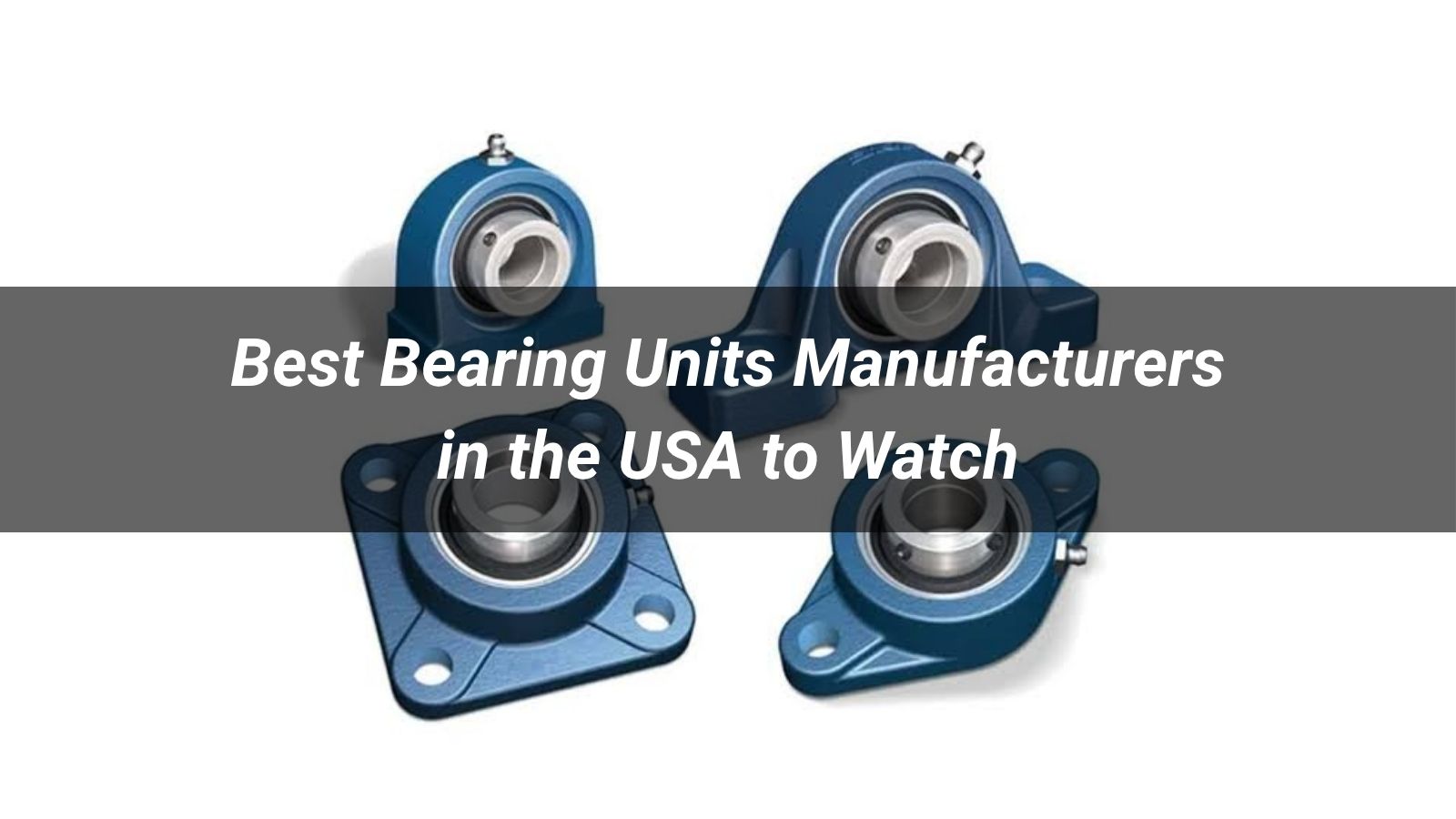 5 Best Bearing Units Manufacturers in the USA 2026
Explore 5 leading bearing unit manufacturers serving the U.S. market in 2026, with key products, applications, and practical buying factors for OEMs, MRO teams, distributors, and industrial buyers.
Read More


