
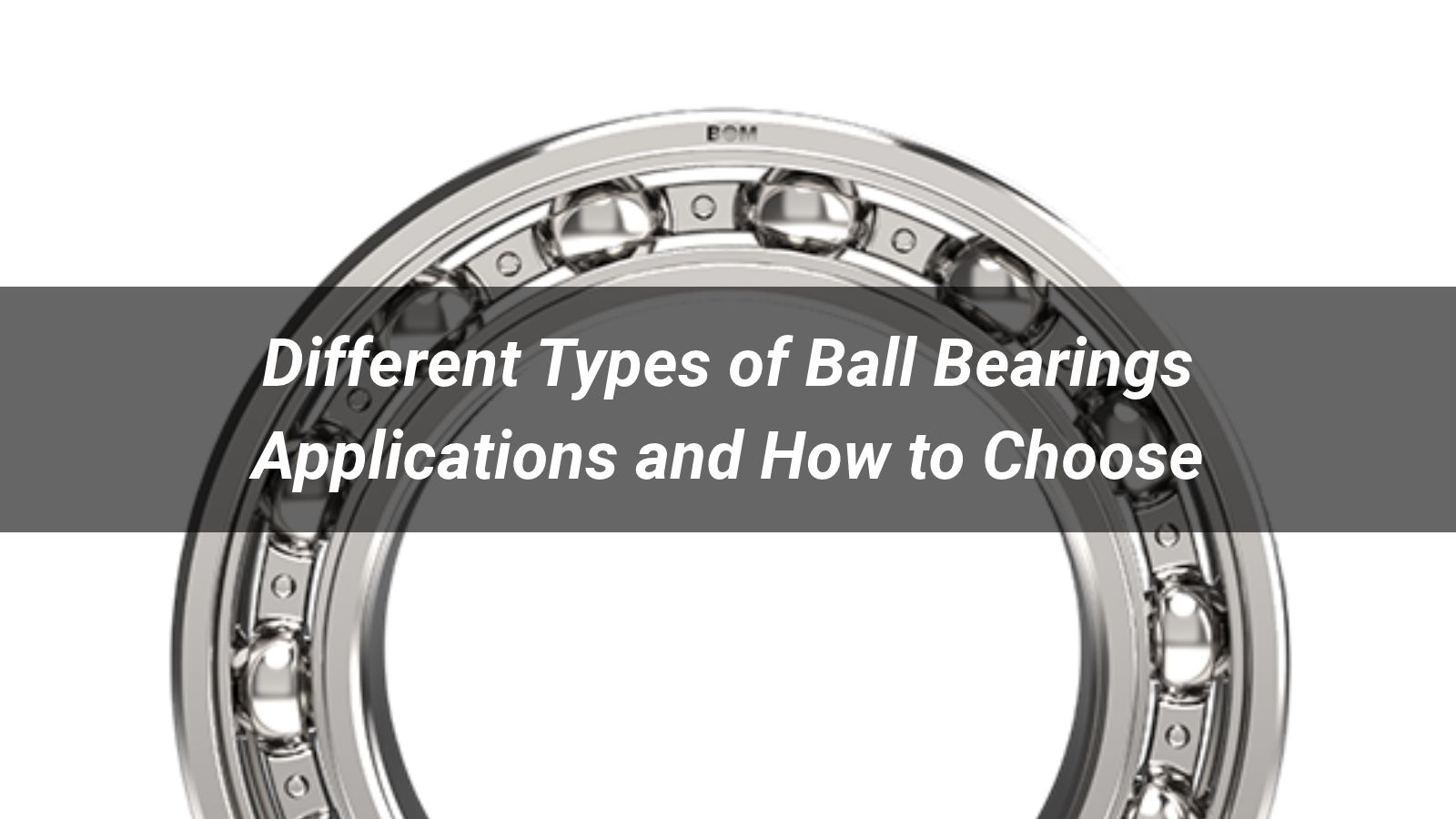
Ball bearing types vary widely because machines face different combinations of load, speed, alignment, and space. From high-speed electric motors to precision machine tools, the right bearing design can directly affect smooth operation, reliability, and service life.
In general, deep groove bearings are versatile for radial and moderate axial loads, while angular contact bearings suit combined loads, self-aligning bearings accommodate shaft misalignment, and thrust bearings are designed mainly for axial loads.
Choosing the right type depends on the actual operating conditions, not simply on which bearing is most common. This guide is especially useful for:
- Engineers and mechanical designers selecting bearings for new equipment
- Maintenance teams replacing worn or damaged bearings
- Purchasing professionals comparing bearing specifications and suppliers
- OEMs looking for bearings matched to specific applications
This guide covers the main ball bearing types, their applications, and the key factors to consider when choosing one.
What Are the Different Types of Ball Bearings?
Ball bearings are designed for different loads, speeds, and operating conditions. The main types include deep groove, angular contact, self-aligning, thrust, insert, and miniature ball bearings.
Each type has a different design and purpose. Some are ideal for high-speed rotation, while others are better for axial loads, combined loads, or shaft misalignment.
The table below gives a quick overview of the main ball bearing types and where they are commonly used.
| Ball Bearing Type | Main Loads | Key Feature | Typical Applications |
|---|---|---|---|
| Deep Groove Ball Bearing | Radial and axial | Versatile and high speed | Motors, fans, pumps |
| Angular Contact Ball Bearing | Radial and axial | Handles combined loads | Spindles, pumps, gearboxes |
| Self-Aligning Ball Bearing | Primarily radial | Accommodates misalignment | Conveyors, agricultural machinery |
| Thrust Ball Bearing | Primarily axial | Designed for axial loads | Turntables, vertical shafts |
| Insert Ball Bearing | Primarily radial | Easy mounting | Conveyors, machinery |
| Miniature Ball Bearing | Depends on design | Compact size | Small motors, instruments |
These are the most common options. The best choice depends on factors such as load direction, operating speed, alignment, and available space.
What Are the Main Ball Bearing Types and How Do They Work?
Although ball bearings share the same basic principle, their internal designs are different. Raceways, contact angles, and ball arrangements determine how each bearing handles loads and movement.
Below are the main ball bearing types and how their designs affect real-world performance.
Deep Groove Ball Bearings
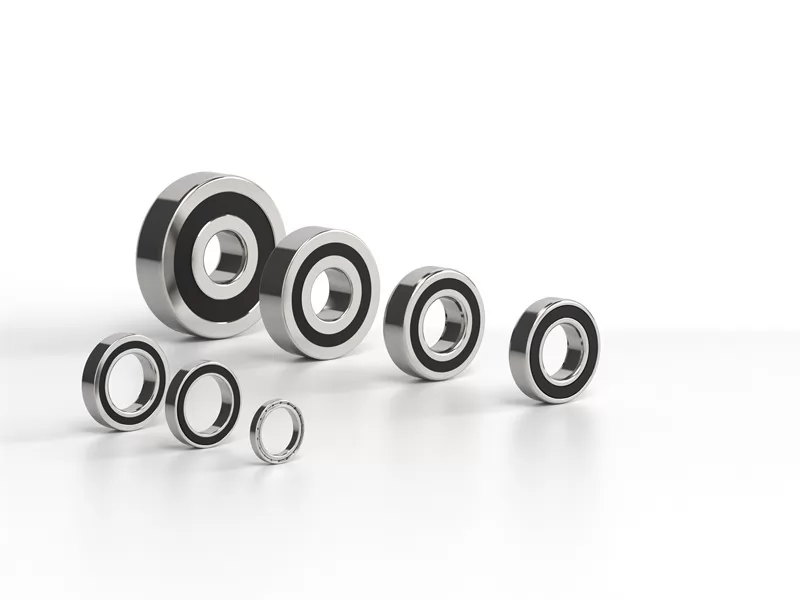
Deep groove ball bearings are one of the most common general-purpose bearing types. Their deep, continuous raceways allow them to support radial loads and moderate axial loads in both directions.
They are also well suited to high-speed rotation, making them a practical choice for motors, fans, pumps, and general machinery.
Example
An electric motor may run continuously for hours. A deep groove bearing helps the shaft rotate smoothly while keeping friction and vibration low.
Angular Contact Ball Bearings
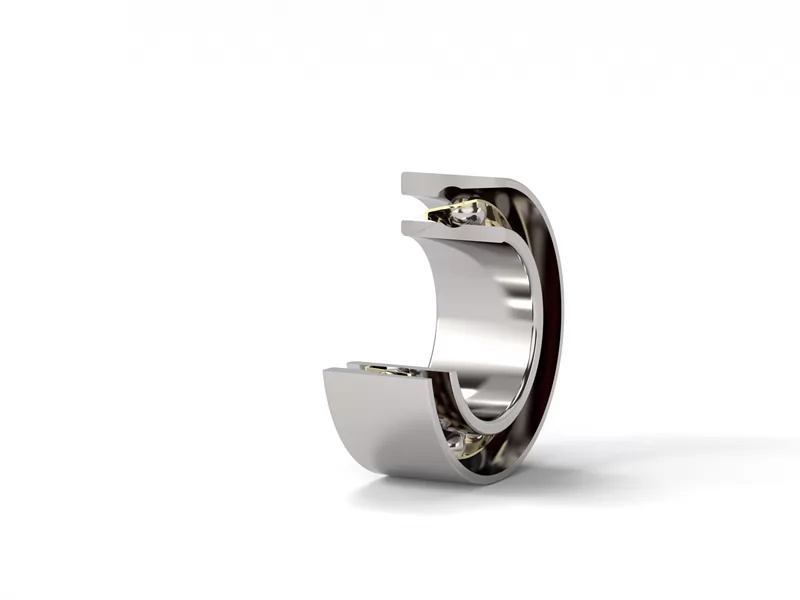
Angular contact ball bearings are designed to handle radial and axial loads at the same time. Their raceways are positioned at an angle, allowing them to transfer axial forces more effectively.
The contact angle affects load capacity and performance. Larger contact angles generally provide greater axial load capacity.
Example
A machine-tool spindle can experience radial cutting forces and axial forces. An angular contact bearing helps support both while maintaining accurate rotation.
_1794983253_WNo_800d600.webp)
Self-Aligning Ball Bearings
Self-aligning ball bearings are designed for applications where shaft and housing alignment may not remain perfectly straight.
Their spherical outer raceway allows the bearing to accommodate small angular misalignments caused by installation errors, shaft deflection, or housing movement.
Example
A long conveyor shaft may flex slightly under load. A self-aligning bearing can accommodate this movement better than a standard bearing.
Thrust Ball Bearings
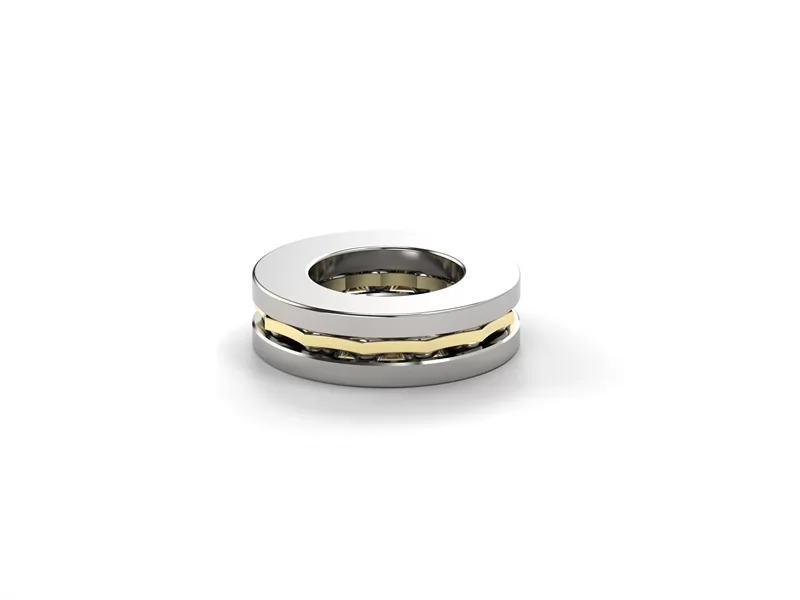
Thrust ball bearings are designed primarily for axial loads. Their main purpose is to support forces acting along the shaft.
Depending on the design, they can support axial loads in one or both directions. They are selected when axial force is more important than radial load capacity.
Example
In a vertical shaft assembly, the weight of the rotating shaft creates an axial force. A thrust bearing can provide support for this load.
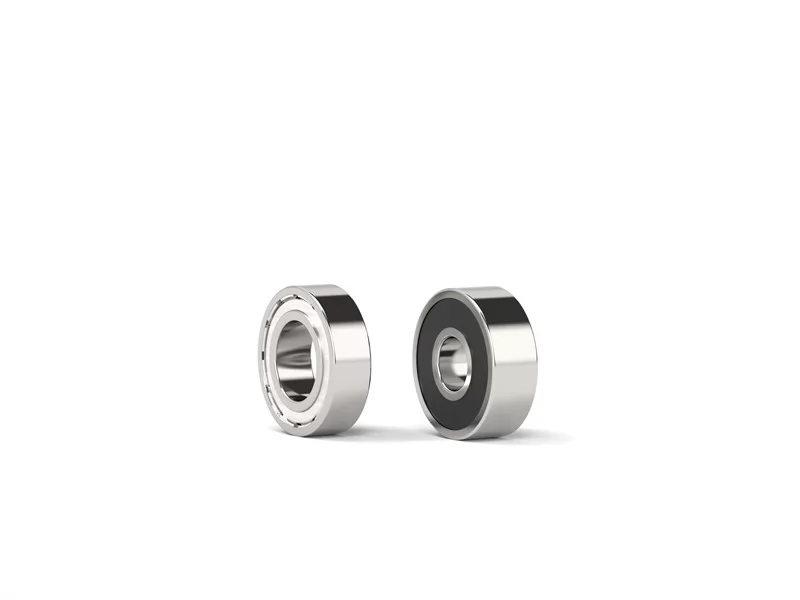
Insert and Miniature Ball Bearings
Insert ball bearings are designed for easy mounting, often in housed bearing units. They are widely used in conveyors, agricultural equipment, and general machinery.
Miniature ball bearings are designed for applications where installation space is limited. They are commonly found in small motors, instruments, and compact mechanisms.
Key Difference
Insert bearings focus on convenient mounting, while miniature bearings focus on compact dimensions and precise rotation.
How Do Different Types of Ball Bearings Compare?
Choosing between different types of ball bearings becomes easier when you compare their load capacity, speed, and operating conditions.
The table below highlights the main differences.
| Type | Radial Load | Axial Load | Misalignment | Typical Strength |
|---|---|---|---|---|
| Deep Groove Ball Bearing | Excellent | Moderate | Limited | General-purpose and high-speed operation |
| Angular Contact Ball Bearing | Excellent | High | Limited | Combined loads |
| Self-Aligning Ball Bearing | Good | Limited | Good | Applications with alignment issues |
| Thrust Ball Bearing | Limited | Excellent | Limited | Primarily axial loads |
| Insert Ball Bearing | Good | Moderate | Application-dependent | Easy installation |
There is no single best ball bearing type for every application. A high-speed motor and a heavily loaded vertical shaft may need completely different bearing designs.
What Are Ball Bearing Types Used For?
Different ball bearing types are used across machinery, transportation, manufacturing, and everyday equipment. The application usually determines which design is most suitable.
For example, deep groove ball bearings are common in electric motors, fans, pumps, and household appliances because they offer a good balance of speed, load capacity, and simplicity.
Angular contact bearings are often found in machine-tool spindles and pumps where radial and axial forces occur together. Self-aligning bearings are useful in conveyors and agricultural machinery where shaft alignment may change during operation.
Thrust ball bearings are suited to applications where axial force is the main concern, such as certain vertical shafts and turntable mechanisms.
In practice, the same machine may even use more than one bearing type. A conveyor, for example, may use insert bearings for easy mounting while other components use deep groove bearings for high-speed rotation.
This is why understanding ball bearing types and applications is important before selecting a bearing for a specific machine.
How Do You Choose the Right Ball Bearing Type?
Choosing a ball bearing starts with the operating conditions, not simply the bearing size. First determine what loads the bearing needs to handle and how the shaft will operate.
1. Load direction is usually the first consideration. Radial loads act perpendicular to the shaft, while axial loads act along the shaft. If both occur together, an angular contact or suitable deep groove bearing may be a better choice.
2. Operating speed is another important factor. High-speed applications generally require bearings designed for low friction and stable operation at higher rotational speeds.
3. Alignment also matters. If the shaft or housing may become slightly misaligned, a self-aligning ball bearing can help accommodate that movement.
A simple selection process is:
- Identify the radial and axial loads.
- Check the required operating speed.
- Consider shaft and housing alignment.
- Check the available installation space.
- Consider temperature, moisture, dust, and other conditions.
What Other Factors Affect Ball Bearing Selection?
Even after choosing the basic bearing type, several details can affect performance and service life.
1. Load rating and bearing size should match the actual operating load. A bearing that is too small may wear prematurely, while an unnecessarily large bearing can increase cost and installation space.
2. Sealing is also important. Open bearings allow easy access for lubrication, while shields and seals provide greater protection against dust, moisture, and other contaminants.
3. Temperature, lubrication, material, and operating environment should also be considered. For example, a bearing operating in a dusty production area may need different protection from one running inside a clean electric motor.
4. Installation and maintenance are equally important. Even the right bearing can perform poorly if it is incorrectly mounted, contaminated, or inadequately lubricated.
Which Ball Bearing Type Should You Use?
There is no single ball bearing that works best for every application. The right choice depends on the load, speed, alignment, and environment.
Use the following as a quick starting point.
| If You Need... | Consider... |
|---|---|
| A versatile bearing for general machinery | Deep Groove Ball Bearing |
| Radial and axial load capacity | Angular Contact Ball Bearing |
| Compensation for minor misalignment | Self-Aligning Ball Bearing |
| Primarily axial load support | Thrust Ball Bearing |
| Easy mounting in a housing | Insert Ball Bearing |
| A bearing for limited installation space | Miniature Ball Bearing |
For example, a standard electric motor will often call for a deep groove bearing, while a precision machine-tool spindle may require an angular contact design.
The best ball bearing type is therefore the one that matches the actual operating conditions rather than simply the most common or largest option.
Frequently Asked Questions About Ball Bearing Types
These are some of the most common questions engineers, buyers, and maintenance teams ask when selecting ball bearings.
What are the different types of ball bearings?
The main types include deep groove, angular contact, self-aligning, thrust, insert, and miniature ball bearings. Each type is designed for different loads, speeds, alignment conditions, and applications.
How can you identify a bearing type?
Start by checking the bearing number, dimensions, and physical design. The bearing number can identify its series and configuration, while the raceway shape and construction can help distinguish types such as deep groove, angular contact, or thrust bearings.
How do you choose the right bearing type?
Match the bearing to the application. Check the radial and axial loads, operating speed, shaft alignment, available space, temperature, and contamination. For example, a high-speed electric motor commonly uses a deep groove bearing, while a machine-tool spindle may require an angular contact bearing.
Conclusion
Choosing the right ball bearing starts with understanding the application. Load direction, operating speed, alignment, space, and working environment all affect the final choice. A deep groove bearing may be ideal for a general-purpose motor, while angular contact, self-aligning, or thrust bearings may be better for more specific requirements.
If you are unsure which bearing fits your equipment, BOM can help evaluate the application and bearing requirements. BOM is a China-based bearing manufacturer providing standard and non-standard bearing solutions for automation, robotics, machinery, agriculture, and other industries.
Share your bearing dimensions, load, speed, application, or drawings with the BOM team. We can review your requirements and provide a suitable bearing solution and quotation.
Need help selecting the right ball bearing?
Send us your requirements and let our team recommend a suitable solution.



